
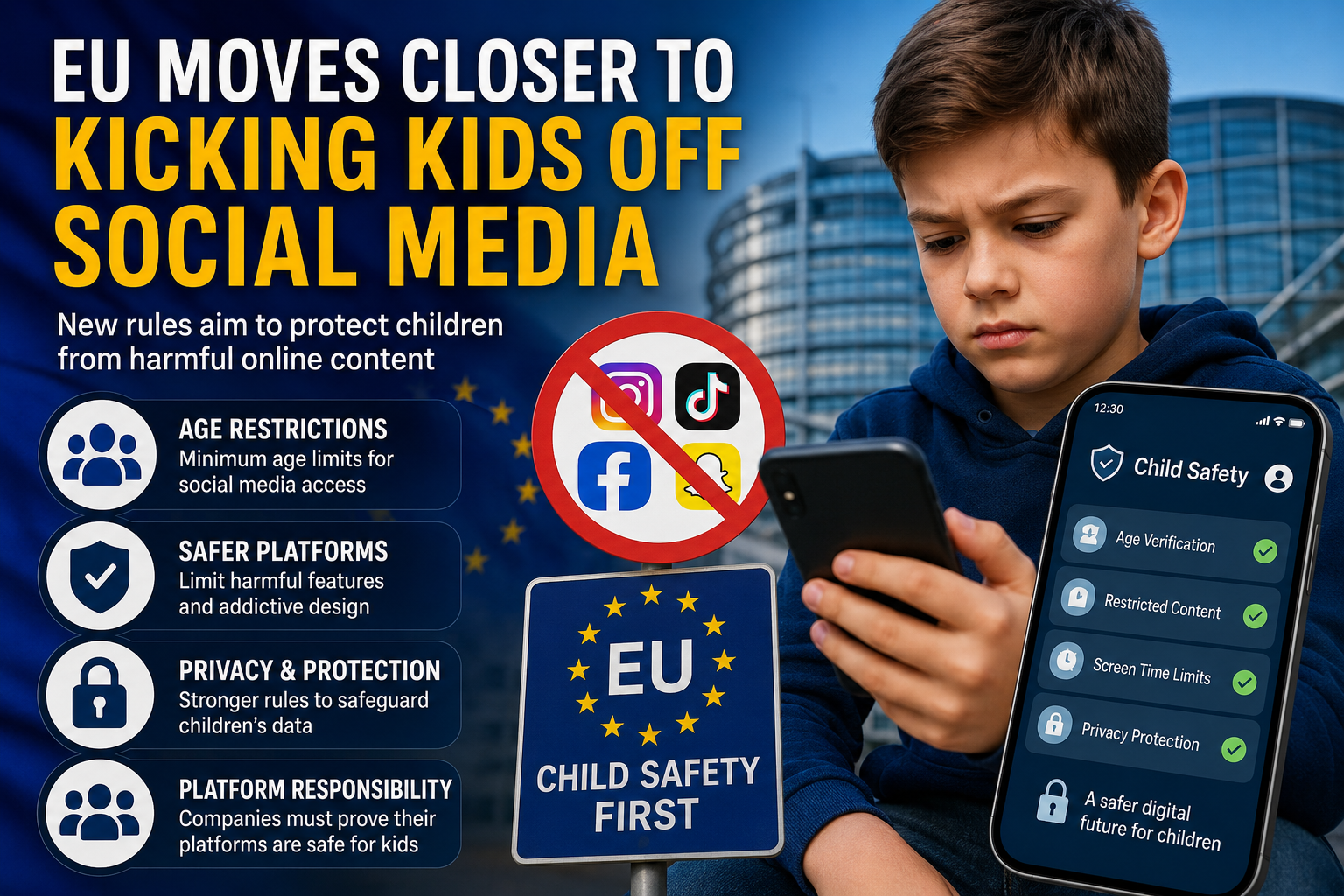
EU Social Media Rules could soon introduce stricter safeguards for children as European policymakers consider new measures to limit minors’ exposure to potentially harmful online platforms and digital features. The proposals, is expected to be shaped by an expert panel’s recommendations, reflect growing concern across Europe about the impact of social media on young users.
The European Commission has confirmed that multiple regulatory options remain under consideration for social media rules, ranging from age restrictions to limits on specific platform features designed to increase user engagement. The initiative follows similar actions taken in other countries and forms part of the European Union’s broader strategy to strengthen online child protection.
EU Reviews New Measures to Protect Children Online
The European Commission is awaiting recommendations from an expert panel tasked with advising on policies to improve children’s online safety. The report is expected to help shape future legislation and digital policy across the European Union.
The debate has gained momentum after Australia became the first country to introduce legislation about social media rules banning children under 16 from using social media platforms. Inspired by that move, several EU member states, including Denmark and Greece, have called for stronger restrictions within Europe.
While some governments support a minimum age requirement for social media access, EU officials have stressed that no final decision has been made. European Commission President Ursula von der Leyen has previously expressed support for stronger protections for minors, although formal proposals are expected later this year following the expert review.
Speaking about the issue, von der Leyen said the central question is not simply when children should gain access to social media, but rather when social media should be allowed access to children.
The Commission has also emphasized that child safety extends beyond social networking services and includes broader online experiences across digital platforms.
Risk-Based Approach May Replace Blanket Ban
Rather than introducing a universal ban, policymakers are increasingly considering a risk-based regulatory model for introducing social media rules.
Under this approach, authorities would focus on limiting digital features considered harmful to children instead of prohibiting entire platforms such as Instagram, TikTok, or Snapchat.
A similar proposal has recently emerged in Germany, where experts suggested maintaining a statutory minimum age while restricting features that encourage excessive engagement.
Among the features receiving increased scrutiny are:
- Endless scrolling mechanisms.
- Personalized recommendation feeds.
- Design elements intended to maximize user engagement.
- Algorithms that repeatedly expose minors to potentially harmful content.
A recent public opinion survey conducted across several European countries found strong support for removing design features considered harmful to children. Many respondents also favored requiring technology companies to demonstrate that their products are safe before allowing minors to access them.
Consumer Protection Commissioner Michael McGrath said future legislation should recognize children as vulnerable consumers and ensure they are protected by design rather than relying solely on parental supervision.
Debate Continues Between Regulation and Digital Rights
The proposals have generated discussion among governments, technology companies, and digital rights organizations.
Supporters argue that stronger social media rules like safeguards are necessary because online platforms increasingly use sophisticated recommendation systems that may encourage prolonged screen time and expose children to inappropriate material.
Others believe responsibility should primarily rest with technology companies rather than families.
Digital rights advocates, however, caution against imposing broad restrictions. Organizations focused on internet freedoms argue that existing European digital laws already provide authorities with significant powers regarding social media rules to regulate major online platforms if fully enforced.
They say regulators should prioritize stronger enforcement against companies that fail to remove harmful content or protect young users instead of excluding children from social media altogether.
The European Union already has legal mechanisms requiring large technology companies to remove illegal and harmful content and restricting targeted advertising directed at children. Officials are also continuing investigations into whether some major platforms adequately protect younger users from addictive digital experiences.
According to EU officials, findings from an ongoing investigation into Meta Platforms regarding the potential impact of its services on children are expected before the end of the summer.
Global Trend Toward Stronger Child Online Safety
The European Union’s review reflects a broader international movement toward stricter regulation of children’s online activity.
Countries including Australia, the United Kingdom, and Indonesia have introduced or are considering measures designed to strengthen online protections for minors. Several EU member states have also proposed their own national legislation, although the European Commission is seeking to ensure consistency across the bloc.
Technology experts believe future regulations for social media rules will likely to focus not only on access but also on how digital services are designed, emphasizing safer user experiences and greater corporate accountability.
For parents, educators, and policymakers, the evolving debate highlights growing international concern over children’s digital wellbeing. Any new EU framework for social media rules/regulation could influence future internet safety policies beyond Europe, particularly as governments worldwide examine the social and psychological effects of prolonged social media use among young people.
Way Forward
The proposed EU Social Media Rules represent one of Europe’s most significant efforts to strengthen online protections for children. While policymakers have not yet decided whether to introduce age restrictions, platform-specific limits, or a broader regulatory framework, there is growing consensus that digital services should place greater emphasis on child safety.
As the European Commission reviews expert recommendations for social media rules and prepares future legislation, technology companies may face increased responsibility for ensuring their platforms are designed with the wellbeing of young users in mind.

Dr. H. Zafar is a distinguished writer and analyst associated with Press Network of Pakistan as Associate Editor. With a strong academic background and years of research experience, she brings depth, clarity, and analytical rigor to her writings.