

ISLAMABAD – Social Media Influencer Tax has emerged as one of the most debated proposals in Pakistan’s Finance Bill 2026, prompting widespread discussion among digital creators, freelancers, businesses and policymakers.
To better understand public opinion, Press Network of Pakistan (PNP) conducted an independent online survey examining attitudes toward the federal government’s decision to impose a 5% withholding tax on income earned by social media influencers through platforms such as YouTube, Facebook, Instagram and TikTok.
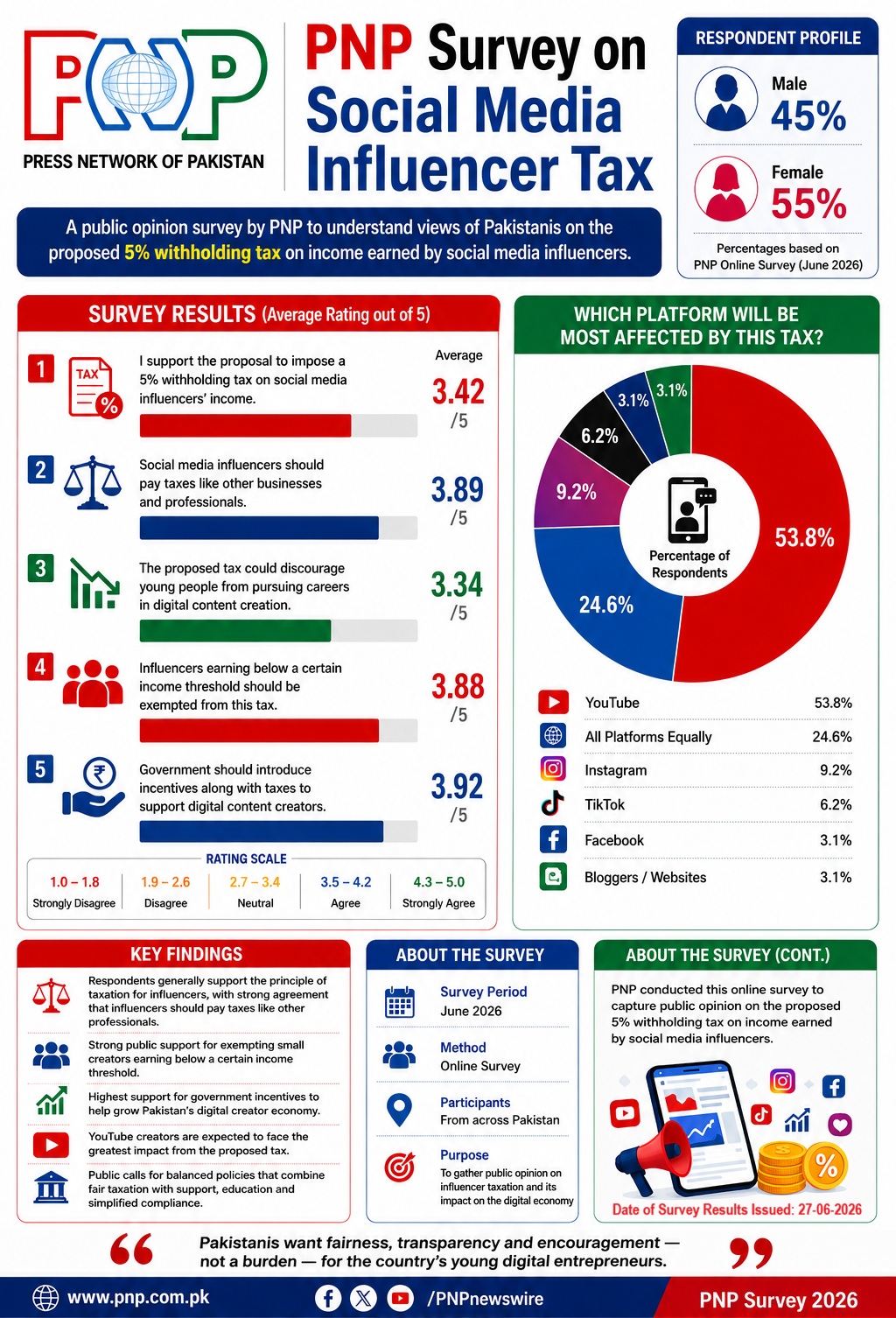
The survey, conducted after the announcement of the proposal in the Finance Bill 2026, received responses from 45 males and 55 females participants representing various age groups, diverse backgrounds and cities across Pakistan. The findings indicate that while respondents generally support the principle that digital content creators should become part of Pakistan’s formal tax system, there is equally strong demand for tax fairness, exemptions for small creators and government incentives to help the country’s rapidly growing digital economy.
The survey reveals that while Pakistanis broadly support bringing the country’s rapidly growing creator economy into the formal tax system, they also want policymakers to ensure that taxation remains fair, transparent and supportive of small digital entrepreneurs.
The survey findings were compiled and officially released on June 27, 2026.
Social Media Influencer Tax Gains Conditional Public Support
The survey demonstrates that respondents generally agree with the principle that successful social media influencers should contribute taxes similar to other professionals.
Participants moderately supported the government’s proposed 5% withholding tax, recording an average score of 3.42 out of 5.
Support became even stronger when respondents were asked whether influencers should pay taxes like businesses and professionals, producing an average score of 3.89 out of 5.
These results suggest that the public largely accepts taxation of digital income but expects implementation to be fair and proportionate.
Survey Shows Strong Demand for Exemptions
One of the clearest messages from the survey concerns protection for smaller creators.
Respondents strongly agreed that influencers earning below a specified income threshold should receive tax exemptions.
This proposal received an average rating of 3.88 out of 5, making it one of the highest-supported policy recommendations.
Participants also expressed concern that imposing taxes too early in a creator’s career could discourage young Pakistanis from entering the digital economy.
The statement that taxation may discourage young people from pursuing careers in digital content creation received an average score of 3.34 out of 5, reflecting mixed but significant concern.
Government Incentives Receive Highest Support
The strongest consensus emerged regarding government support measures.
Respondents awarded an average score of 3.92 out of 5 for introducing incentives alongside taxation.
Participants indicated that taxation should be accompanied by:
- Digital entrepreneurship support
- Simplified tax filing
- Training opportunities
- Export promotion
- Startup incentives
- Financial literacy programmes
- Transparent taxation policies
These findings indicate that the public prefers a balanced approach that combines tax compliance with economic growth.
YouTube Seen as Most Affected Platform
Respondents identified YouTube as the platform most likely to experience the greatest financial impact.
Survey responses indicate:
| Platform | Percentage |
|---|---|
| YouTube | 53.8% |
| All Platforms Equally | 24.6% |
| 9.2% | |
| TikTok | 6.2% |
| 3.1% | |
| Bloggers/Websites | 3.1% |
The findings reflect YouTube’s dominant role in Pakistan’s creator economy, where thousands of individuals rely on advertising revenue, sponsorships and digital content production.
Respondent Profile
The survey also reflects balanced gender participation.
| Gender | Percentage |
|---|---|
| Female | 55% |
| Male | 45% |
This balanced representation provides valuable insight into public opinion across different demographic groups.
Key Findings at a Glance
The survey highlights five major conclusions:
- Public generally supports taxing successful social media influencers.
- Most respondents believe influencers should pay taxes like other businesses.
- Strong support exists for exempting small creators below a defined income threshold.
- Government incentives received the highest level of public support.
- YouTube creators are expected to experience the greatest impact from the proposed tax.
Comparative Analysis: How Other Countries Tax Influencers
Pakistan is not alone in introducing taxation for digital creators. Several respondents, in thier remarks, mentioned that major economies already tax influencer income through existing income tax systems rather than imposing separate social media taxes. For example:
| Country | Tax Approach |
|---|---|
| United States | Influencer income taxed as business income. |
| United Kingdom | Digital earnings declared through self-assessment. |
| Canada | Business income subject to normal taxation. |
| Australia | Influencers pay income tax with deductible business expenses. |
| Germany | Creator income treated as commercial income. |
| India | Digital creators taxed under existing income tax laws with TDS in applicable cases. |
| Pakistan (Introduced) | 5% withholding tax on platform revenues. |
Unlike many developed economies, Pakistan proposes a withholding tax at the payment stage, making compliance relatively straightforward but raising concerns regarding fairness for small creators. The PNP survey findings noted.
Economic Impact on Pakistan’s Digital Economy
Pakistan’s digital creator economy has expanded rapidly over the past decade.
Thousands of Pakistanis now generate income through:
- YouTube
- Facebook monetisation
- Instagram collaborations
- TikTok content
- Affiliate marketing
- Freelancing
- Podcasts
- Online education
- Gaming
- Digital consulting
Formal taxation could improve documentation of digital income while expanding Pakistan’s tax base.
However, some respondents suggest that excessive taxation without supportive policies could discourage entrepreneurship and reduce foreign exchange earnings generated through digital exports.
PNP Policy Recommendations
Based on survey findings, Press Network of Pakistan recommends:
- Introduce income-based exemptions for small creators.
- Establish progressive taxation based on annual earnings.
- Simplify tax filing procedures.
- Allow deductions for legitimate business expenses.
- Promote digital entrepreneurship.
- Conduct nationwide tax awareness campaigns.
- Consult industry stakeholders before final implementation.
- Encourage voluntary compliance rather than punitive enforcement.
Why These Findings Matter
Pakistan’s digital economy represents one of the country’s fastest-growing employment sectors.
With youth unemployment remaining a major national challenge, policymakers face the task of balancing revenue generation with innovation.
The PNP survey suggests that citizens do not oppose taxation itself. Instead, they seek fairness, transparency and incentives that encourage creators to expand their businesses while contributing to national development.
These findings provide policymakers with valuable evidence that taxation should support—not hinder—the continued growth of Pakistan’s digital economy.
Conclusion
The PNP Survey demonstrates that Pakistanis generally support the idea that social media influencers should contribute to the national tax system. However, respondents also clearly believe that taxation should be fair, progressive and accompanied by supportive policies that encourage innovation and digital entrepreneurship.
The findings suggest that the success of the proposed 5% withholding tax will depend not only on revenue collection but also on the government’s ability to build confidence among creators by introducing exemptions for smaller earners, incentives for digital businesses and a transparent implementation framework.
As Pakistan’s digital economy continues to expand, balanced policymaking will be essential to ensure that taxation strengthens rather than hinders one of the country’s fastest-growing sectors.