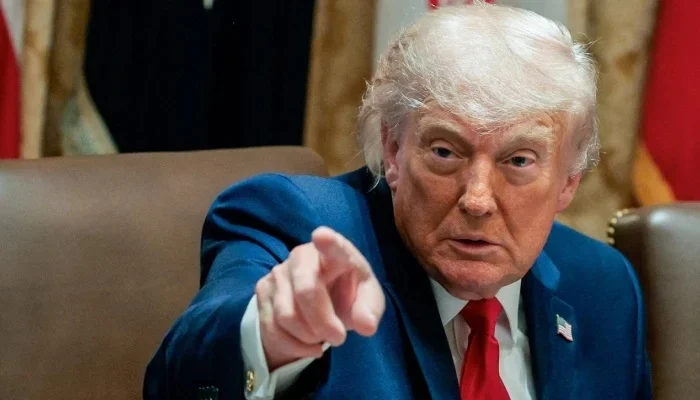
WASHINGTON: US President Donald Trump has announced what he described as an unprecedented Iran economic war, threatening sweeping economic action against Tehran and warning that countries, companies and financial institutions providing economic support to Iran could face serious consequences.
In a post on Truth Social, Trump said his administration would pursue what he called economic warfare and isolation on an unprecedented scale after accusing Iran of failing to reach an agreement with Washington.
Trump described the planned measures as the “MOST CRUSHING ECONOMIC OPERATION EVER TAKEN AGAINST ANY COUNTRY” and urged US allies to support efforts aimed at increasing Iran’s economic isolation.
“No one has given the Islamic Republic of Iran a greater opportunity to make a Deal than me,” Trump said, adding that Tehran had failed to accept the opportunity.
The announcement comes amid continued tensions involving Iran, the United States, the Strait of Hormuz and Tehran’s nuclear programme, while diplomatic channels remain active despite increasingly confrontational public statements from both sides.
Iran economic war targets financial and commercial support
Trump said countries or entities that provide what he described as an economic “lifeline” to Iran could face “TREMENDOUS Economic Consequences.”
His warning extended to financial institutions, businesses, airports and government-linked entities involved in commercial or financial activity that could support Tehran.
Trump specifically identified several areas that could come under greater scrutiny, including alleged oil smuggling, currency and cash transfers, swap arrangements, exchange houses, ship registries and front companies.
“It all needs to stop NOW,” he said.
The US president described the planned escalation as an “ECONOMIC D-DAY,” suggesting that Washington intends to increase pressure not only on Iran but also on networks and countries that help Tehran maintain trade, financial transactions or other economic links.
The language points to the possibility of a broader enforcement campaign against sanctions evasion and indirect commercial activity. However, Trump’s announcement did not provide detailed information on the legal mechanisms, timeline or specific sanctions measures that would be introduced.
Washington has previously relied on sanctions targeting Iranian energy exports, financial institutions, shipping networks and individuals or companies accused of helping Iran bypass restrictions. A wider campaign could increase pressure on businesses and governments seeking to maintain economic engagement with Tehran.
Trump reiterates opposition to Iranian nuclear weapons
Trump also repeated his administration’s position that Iran must not be allowed to acquire a nuclear weapon.
“IRAN WILL NEVER HAVE A NUCLEAR WEAPON,” Trump said.
The Iranian nuclear programme has remained one of the central issues in the long-running dispute between Tehran and Washington. The United States and its allies have sought restrictions on Iran’s nuclear activities, while Iranian authorities have maintained that the country’s nuclear programme is intended for peaceful purposes.
Trump also made a series of claims regarding Iran’s military capabilities, saying Iran’s navy and air force had been severely damaged and that military factories had been reduced to rubble. He further claimed that Iran’s currency had become effectively worthless.
Those claims formed part of Trump’s broader argument that increased economic pressure could further weaken Iran’s ability to support regional allies and armed groups.
He said the planned campaign would limit Tehran’s ability to “project terror worldwide,” language that reflects Washington’s longstanding criticism of Iran’s regional role and its support for allied groups.
Strait of Hormuz remains central to regional tensions
Trump’s announcement also focused attention on the Strait of Hormuz, one of the world’s most strategically important maritime routes for global energy supplies.
The US president said the waterway remained open and that vessels were continuing to move through the strait, despite what he described as an “extremely effective” US naval blockade.
“The Strait is open. A lot of boats are coming through,” Trump said, arguing that public reporting had not fully reflected the situation.
The Strait of Hormuz is a key transit route for global oil and liquefied natural gas shipments. Any prolonged disruption or escalation involving maritime traffic could have wider consequences for energy markets, shipping costs and the economies of countries dependent on energy imports.
The situation is also closely watched across South Asia and the Gulf, where governments have economic and strategic interests in maintaining stable maritime trade routes.
For Pakistan, developments in the Gulf and any further escalation involving Iran could carry economic and diplomatic implications. Pakistan shares a border with Iran and has traditionally maintained engagement with Tehran while also preserving close relations with Gulf states and the United States.
A broader campaign to isolate Iran could therefore increase diplomatic pressure across the region and complicate efforts by neighbouring countries to balance competing strategic relationships.
Tehran signals diplomacy but rejects negotiations under pressure
Iranian leaders, meanwhile, have continued to signal that Tehran remains open to diplomacy while rejecting negotiations that they believe undermine the country’s sovereignty or national interests.
Iranian President Masoud Pezeshkian said that “negotiation is not surrender,” according to the ISNA state news agency.
He argued that any diplomatic engagement should take place from a position of strength and should focus on ending the conflict, lifting economic pressure, releasing blocked resources and eventually addressing nuclear issues.
“We defend territorial integrity, but war is not our goal,” Pezeshkian said.
His remarks reflect the contrasting messages emerging from Tehran, where officials have indicated a willingness to pursue diplomacy but have rejected the idea of negotiating under what they describe as coercive conditions.
Iranian Parliament Speaker Mohammad Bagher Ghalibaf adopted a more confrontational tone during remarks in Baghdad, accusing the United States of seeking control over the resources of countries in the region.
According to Iran’s Fars news agency, Ghalibaf described Washington as the “biggest problem” and the main cause of instability in the region. He also claimed that the United States had suffered military and political setbacks in what he called the “third imposed war.”
The differing statements highlight the internal balance within Iran between keeping diplomatic options open and publicly resisting US pressure.
Diplomatic contacts continue despite escalating rhetoric
Despite the sharp language surrounding the Iran economic war, regional diplomatic activity has continued.
Iranian Foreign Minister Abbas Araghchi held a telephone conversation with Chief of Defence Forces Field Marshal Asim Munir to discuss regional developments, diplomatic efforts and possible political solutions, according to the Iranian government.
The discussion also covered ways to strengthen bilateral consultations and cooperation between Pakistan and Iran.
The contact underscores Pakistan’s potential importance in regional diplomacy as tensions continue to affect neighbouring countries and broader international security.
Pakistan has consistently supported dialogue and political engagement to address regional disputes and has an interest in preventing a wider conflict that could threaten border security, trade routes and energy markets.
The continued diplomatic engagement between Islamabad and Tehran comes as regional governments assess the consequences of a possible expansion of US economic pressure.
What Trump’s economic escalation could mean
Trump’s latest announcement increases uncertainty over whether Washington and Tehran will move toward renewed negotiations or a deeper economic confrontation.
The US president has previously suggested that talks with Iran could take place “at some point,” without providing a timetable or setting out specific conditions for renewed negotiations.
Iran, meanwhile, has maintained that diplomacy remains possible but that any negotiations must respect its sovereignty and national interests.
A major expansion of sanctions enforcement could create new risks for international businesses, banks, shipping companies and governments with commercial links to Iran. Secondary economic measures could also affect companies outside the United States if Washington decides to target entities accused of helping Tehran circumvent restrictions.
The consequences could extend beyond Iran’s borders, particularly if tensions affect shipping through the Strait of Hormuz or create further instability in the Middle East.
For the international community, the central question remains whether economic pressure will push the two sides back toward negotiations or further reduce the political space for diplomacy.
Conclusion
Trump’s announcement marks a new escalation in Washington’s public pressure campaign against Tehran, combining threats of wider economic action with renewed warnings over Iran’s nuclear programme and regional activities.
At the same time, Iranian leaders continue to insist that diplomacy remains possible, although they have rejected negotiations conducted under pressure.
With strategic waterways, global energy markets, regional security and the future of Iran’s nuclear programme all at stake, the coming diplomatic response from Tehran, Washington and regional powers will be closely watched.
The direction of the crisis may depend on whether the escalating Iran economic war leads to greater isolation and confrontation or creates new pressure for a negotiated political settlement.
Naeem Akhtar plays a key role in shaping editorial content and maintaining the highest standards of accuracy and clarity. His dedication ensures that PNP’s coverage remains timely, reliable, and impactful for its readers worldwide.