
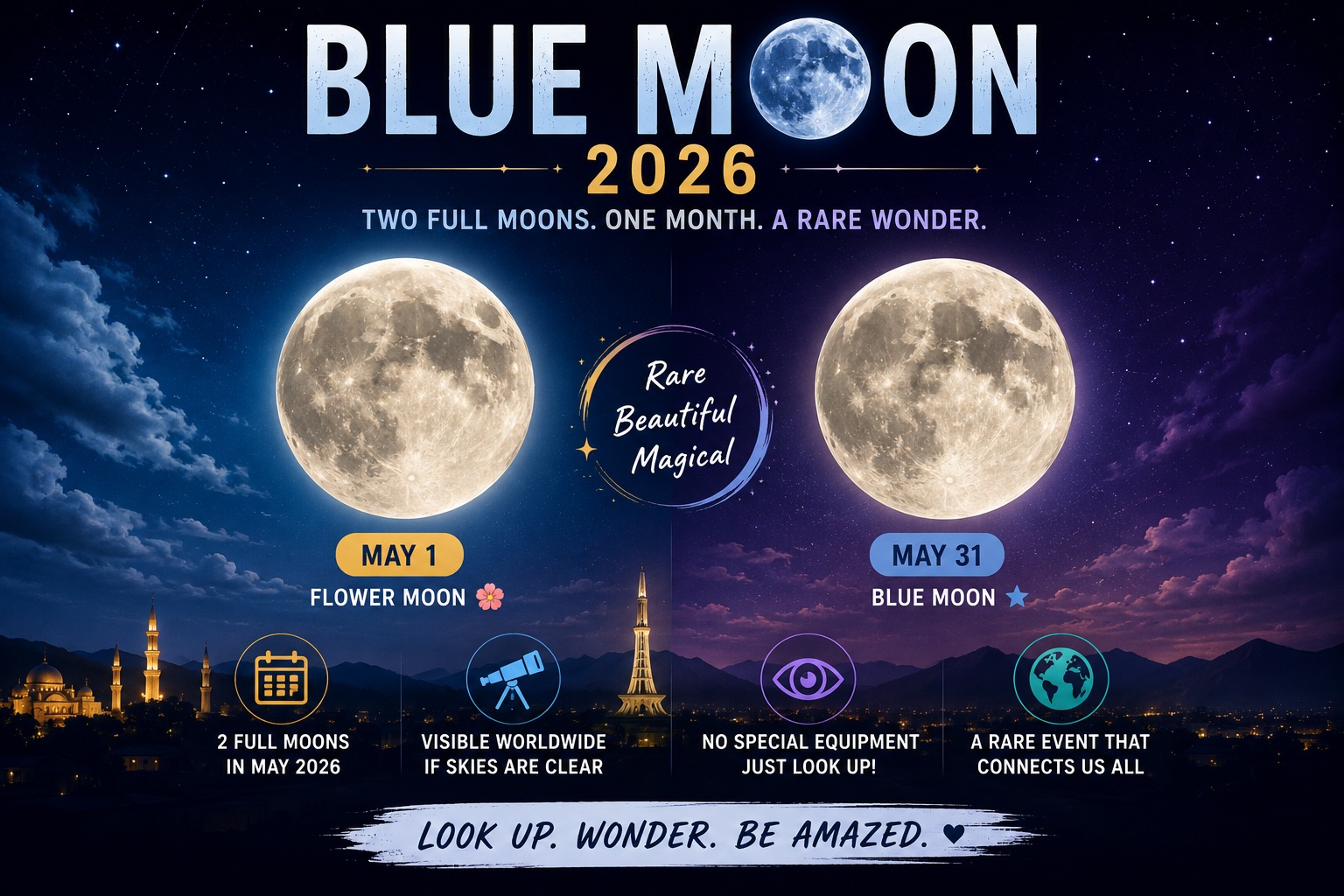
The night sky offered a rare celestial spectacle on May 31, 2026, when skywatchers in Pakistan and many other countries witnessed the second full moon of the month. This unusual event is commonly known as a Blue Moon, a phenomenon that occurs only occasionally and has inspired myths, traditions, and scientific curiosity for centuries.
Despite its name, the Moon did not appear blue. Instead, it shone brightly like a silver plate in the night sky. Yet astronomers and moon enthusiasts across the world paid special attention because this was the second full moon to occur within the same Gregorian calendar month.
What Is a Blue Moon?
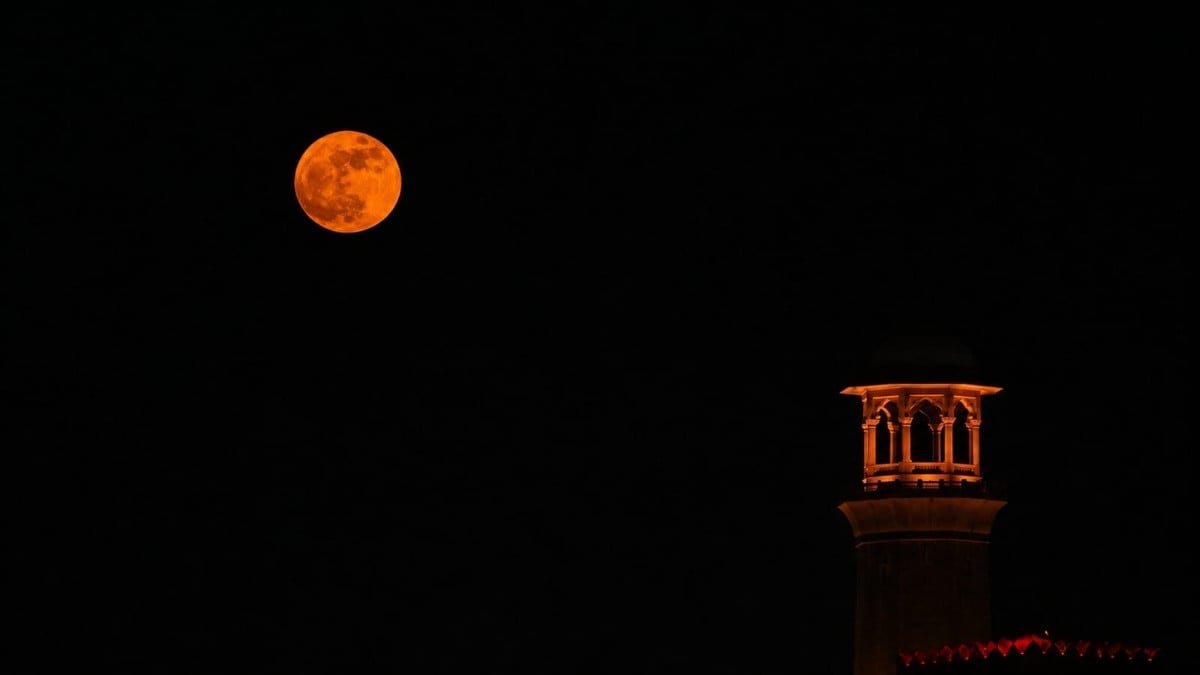
A Blue Moon is traditionally defined today as the second full moon occurring within a single calendar month.
In May 2026, the first full moon appeared on May 1, while the second occurred on May 31, creating the rare Blue Moon event.
Because the average interval between full moons is about 29.53 days, it is uncommon for a month to contain two full moons. This can happen only in months with 31 days when the first full moon occurs during the opening days of the month.
The phrase “once in a blue moon” has therefore become a popular English expression used to describe something rare or unusual.
Why Wasn’t the Moon Blue?
One of the biggest misconceptions about a Blue Moon is that it turns blue in color.
In reality, a Blue Moon usually looks exactly like any other full moon. The name has nothing to do with its appearance.
In European culture, the color blue was historically associated with rarity. Just as some cultures associate red with anger or white with peace, Europeans often used blue to describe something uncommon. Over time, the term “Blue Moon” became linked to rare lunar events.
Although atmospheric conditions such as volcanic eruptions or large forest fires can occasionally make the Moon appear bluish, that is unrelated to the astronomical definition of a Blue Moon.
How Do Full Moons Occur?
A full moon occurs when the Sun, Earth, and Moon align in a straight line, with Earth positioned between the Sun and the Moon.
At this moment, the side of the Moon facing Earth is fully illuminated by sunlight, creating the familiar bright circular disk in the sky.
The Moon takes approximately 27.3 days to orbit Earth. However, because Earth is also moving around the Sun, the Moon must travel slightly farther to reach the same alignment again.
As a result, the interval between full moons averages about:
29.53 days29.53\ \text{days}
This period is known as the synodic month, which equals approximately 29 days, 12 hours, and 44 minutes.
Why Are Two Full Moons in One Month So Rare?
The rarity of a Blue Moon comes from the relationship between lunar cycles and the Gregorian calendar.
| Factor | Duration |
|---|---|
| Average Full Moon Cycle | 29.53 days |
| February | 28 or 29 days |
| Some Months | 30 days |
| Longest Months | 31 days |
Since the lunar cycle is almost 30 days long, most months contain only one full moon.
A Blue Moon can occur only when:
- A month contains 31 days.
- The first full moon occurs during the first few days of the month.
- Enough days remain for another full moon before the month ends.
That is exactly what happened in May 2026.
The Blue Moon and the Micro Moon Connection
The May 31 Blue Moon was also a Micro Moon.
A Micro Moon occurs when a full moon happens while the Moon is near its farthest point from Earth, known as Apogee.
The Moon does not orbit Earth in a perfect circle. Instead, it follows an elliptical path.
Key Lunar Positions
| Position | Description |
|---|---|
| Perigee | Closest point to Earth |
| Apogee | Farthest point from Earth |
When the Moon is at Perigee, it appears slightly larger and brighter, creating what is often called a Supermoon.
When it is near Apogee, it appears slightly smaller, resulting in a Micro Moon.
The May 31, 2026 Blue Moon occurred near Apogee, making it a Micro Moon. However, the difference in size was so small that most observers could not easily notice it with the naked eye.
The Original Meaning of Blue Moon
Interestingly, the modern definition of Blue Moon is not the original one.
Historically, astronomers divided the year into seasons. Each season lasts approximately 91 days, and normally contains three full moons.
However, because lunar cycles do not perfectly match seasonal divisions, some years contain 13 full moons instead of 12.
When a season contained four full moons, the third full moon was traditionally called a Blue Moon.
This older definition was used for centuries in Europe and appeared in traditional almanacs.
How the Modern Definition Became Popular
The modern meaning emerged because of a misunderstanding.
In 1937, the famous publication Maine Farmers’ Almanac described the traditional seasonal Blue Moon.
Later, a popular astronomy writer incorrectly interpreted the explanation and stated that the second full moon in a calendar month was a Blue Moon.
Although the interpretation was technically incorrect, it became widely accepted through magazines, newspapers, television programs, and eventually the internet.
Today, when most people refer to a Blue Moon, they mean the second full moon within the same month.
Moon Names Around the World
Many cultures have given special names to full moons throughout the year.
Native American traditions associated each full moon with seasonal events.
| Month | Traditional Name |
|---|---|
| January | Wolf Moon |
| February | Snow Moon |
| March | Worm Moon |
| April | Pink Moon |
| May | Flower Moon |
| June | Strawberry Moon |
| July | Buck Moon |
| August | Sturgeon Moon |
| September | Harvest Moon |
| October | Hunter’s Moon |
| November | Beaver Moon |
| December | Cold Moon |
The first full moon of May 2026 was known as the Flower Moon, reflecting the blooming season in many parts of the Northern Hemisphere.
The second full moon later became the month’s Blue Moon.
Blue Moon in Pakistan
For skywatchers in Pakistan, the Blue Moon provided a wonderful opportunity to observe and appreciate celestial mechanics.
Unlike eclipses or meteor showers, a Blue Moon requires no special equipment. Anyone with a clear sky could enjoy the spectacle from cities such as Islamabad, Lahore, Karachi, Peshawar, Quetta, and rural areas across the country.
Pakistan’s rich tradition of lunar observation, particularly for Islamic months and religious occasions, makes such astronomical events especially interesting for the public.
While the Blue Moon itself has no religious significance in Islam, it offers a valuable opportunity to understand the science behind the Moon’s movement and humanity’s long-standing fascination with the night sky.
Different Lunar Calendars, Different Perspectives
Not all cultures define months in the same way.
In some Indian traditions, a month is measured from one full moon to the next, known as Purnimanta.
Other traditions calculate months from one new moon to the next, known as Amanta.
This highlights an important fact: the modern Blue Moon is largely a cultural concept based on the Gregorian calendar rather than a unique astronomical event.
Conclusion
The Blue Moon 2026 was a rare and fascinating event that illuminated skies around the world on May 31. Although it was neither blue nor dramatically different from other full moons, its rarity captured public imagination.
The event demonstrated how astronomy, culture, history, and calendar systems intersect in surprising ways. Whether viewed from Pakistan, Europe, North America, or elsewhere, the Blue Moon served as a reminder that even familiar celestial objects can still inspire wonder.
After all, there is a reason people still say something happens “once in a blue moon.” It is a rare moment worth looking up for.