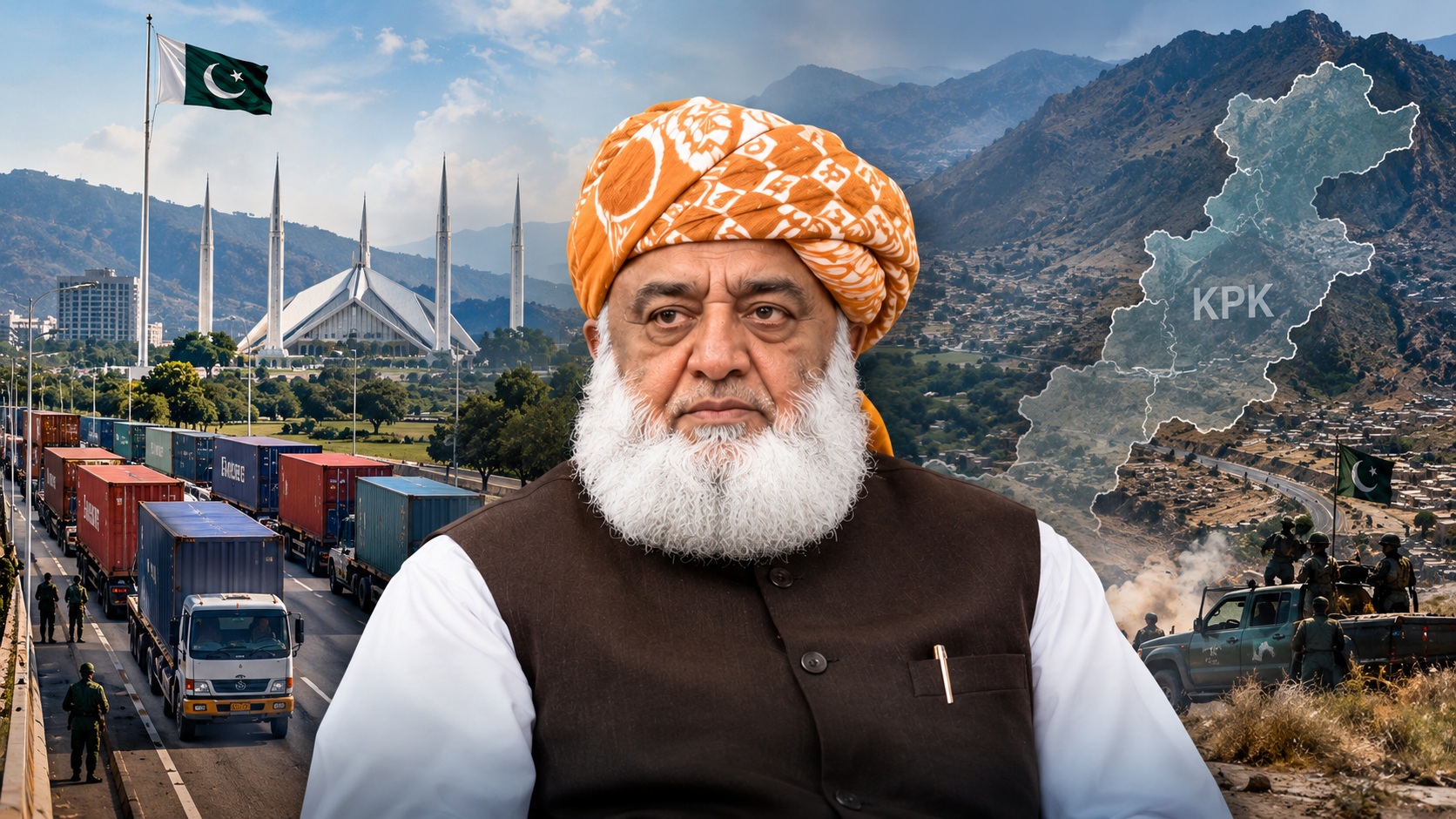
ISLAMABAD (PNP) – Jamiat Ulema-e-Islam (F) chief Maulana Fazalur Rehman made a sustained effort to prevent an escalation of the political confrontation between the federal government and Pakistan Tehreek-e-Insaf (PTI), seeking a negotiated settlement over tensions surrounding Khyber Pakhtunkhwa, according to a BBC Urdu report detailing the final days of the talks.
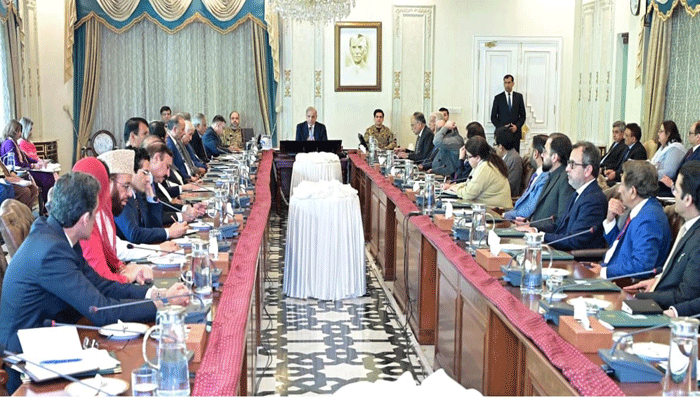
Maulana Fazalur Rehman held meetings with Prime Minister Shehbaz Sharif and PTI representatives, attempting to bridge differences over the party’s proposed long march, access to former prime minister Imran Khan and arrangements for his medical treatment. His mediation temporarily coincided with a pause in the planned march and a postponement of the government’s proposed emergency measures.
The JUI-F leader said these developments had led him to believe that both sides were prepared to reach an understanding. However, the negotiations ultimately broke down, with government representatives and PTI leaders offering different accounts of why the effort failed.
The episode highlights the potential role of political intermediaries in resolving disputes when direct negotiations between rival parties reach an impasse. It also illustrates the limitations of mediation when the parties disagree over the scope of talks and the conditions required for a settlement.
Maulana Fazalur Rehman Tries to Reopen the Door to Dialogue
Reportedly, Maulana Fazal ur Rehman returned to Islamabad on October 7 after performing Umrah in Saudi Arabia. A senior PTI delegation met him later that day and requested that he help resolve the developing political crisis.
Fazal ur Rehman said he initially believed the government had left little room for negotiations. However, on October 8, National Assembly Speaker Sardar Ayaz Sadiq and several federal ministers approached him and requested his assistance.
The JUI-F chief said he had received information before his return that emergency measures might be introduced in Khyber Pakhtunkhwa the following day.
His intervention was followed by a temporary pause in the planned PTI march towards Islamabad and a postponement of the government’s proposed action. Fazalur Rehman interpreted these developments as evidence that both sides might be willing to compromise.
The mediation effort was significant because the dispute had become difficult to resolve through direct contact. According to a government minister quoted by BBC Urdu, earlier discussions at the National Assembly speaker’s office had revealed that PTI’s federal leaders did not consider themselves authorized to call off the march.
That impasse created an opening for an intermediary who could communicate with both the government and the opposition.
Meetings With Shehbaz Sharif Focus on a Possible Compromise
According to media reports, Prime Minister Shehbaz Sharif invited him to dinner on October 9, where the government’s position became clearer.
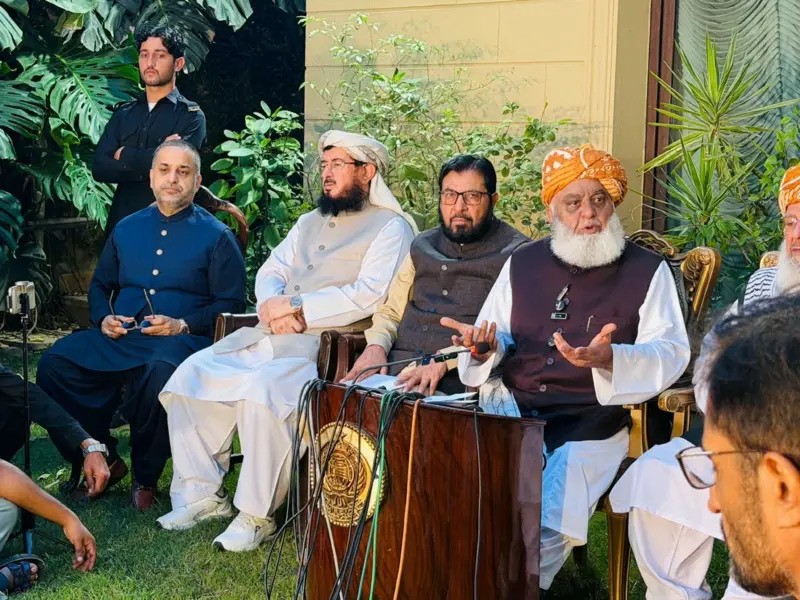
According to the JUI-F leader, the government wanted PTI to announce the termination of its long march before further concessions were considered. PTI, meanwhile, wanted access to Imran Khan and medical treatment for him in accordance with court directions.
Fazalur Rehman said he proposed speaking with PTI’s provincial leadership before attempting to finalize an agreement.
He subsequently met the prime minister again at around 6 a.m. on October 10, with Deputy Prime Minister and Foreign Minister Ishaq Dar also present.
According to Fazalur Rehman, he suggested that if PTI was prepared in principle to call off the march, the government should agree to facilitate the requested meeting with Imran Khan and his medical treatment. He proposed that the parties then work through the practical arrangements and implementation sequence.
Fazalur Rehman said the prime minister responded positively and mentioned that a federal cabinet meeting was scheduled for that morning. The JUI-F chief also said the parties had discussed announcing an understanding in the presence of two representatives each from the government and PTI after consulting the provincial leadership.
His account portrays the mediation effort as an attempt to establish reciprocal commitments rather than require one side to concede everything before the other responded.
However, the account is based on Fazalur Rehman’s statements. Government representatives subsequently described the final stage of the negotiations differently.
Why the Negotiations Collapsed
Fazalur Rehman told reporters that he received a call from the prime minister at approximately 9:30 a.m. on October 10. He said Shehbaz Sharif informed him that his proposals would be presented to the cabinet for consideration.
The JUI-F leader said he expected a favourable response. According to his account, Ishaq Dar called him around 10:30 a.m. and conveyed that the cabinet favoured emergency measures and governor’s rule in Khyber Pakhtunkhwa.
Fazalur Rehman questioned the justification for such measures, arguing that the government’s concerns about militancy should be assessed consistently across provinces. He asked why similar standards were not being applied to Balochistan, where security challenges also existed.
He subsequently accused the government of withdrawing from an understanding and rejected the proposed measures as an infringement on democracy and the rights of the people.
Fazalur Rehman said he intended to oppose the decision through public mobilization, parliamentary action and the courts.
His criticism placed the emphasis on political negotiation and the need for the government to exhaust avenues for agreement before taking extraordinary steps.
Government Says Security Concerns Were Central
Interior Minister Mohsin Naqvi offered a different account of the breakdown.
Speaking at a press conference with other federal ministers, Naqvi said the government and PTI had worked through four drafts during negotiations. He said the opposition had raised objections to paragraph four of the final draft and had been asked to propose alternative wording.
Naqvi said he remained in contact with PTI leaders until shortly before midnight on October 10. He maintained that the government had offered a final opportunity to resolve the dispute and avoid the planned measures.
According to the interior minister, the federal government was primarily concerned about terrorism and security, rather than the protest itself.
Federal Parliamentary Affairs Minister Dr Tariq Fazal Chaudhry similarly said the government wanted the Khyber Pakhtunkhwa administration to cooperate with the federation in countering militancy.
He stated that the government had sought a positive response from PTI leadership but had not received one before the decision was taken.
A government official cited by BBC Urdu said the federal cabinet was briefed about the security situation and the provincial administration’s response before approving the proposal for emergency measures and governor’s rule.
The government’s position was therefore that the dispute had moved beyond political protest to questions of security and cooperation between federal and provincial authorities.
PTI Says Talks Were About Imran Khan’s Health and Treatment
PTI representatives also disputed the government’s explanation.
Ali Muhammad Khan, a PTI member of the National Assembly and former minister, told BBC Urdu that the discussions with government representatives had focused on Imran Khan’s health and medical treatment.
He said the government wanted security issues incorporated into the negotiations, while PTI maintained that its immediate demands concerned Imran Khan and related matters.
Ali Muhammad Khan blamed what he described as the government’s inflexibility for the breakdown.
His account differed from the government’s insistence that cooperation against militancy had to be part of any understanding.
The disagreement over the agenda was central to the impasse. The government wanted commitments on security and the planned march, while PTI prioritized access to its incarcerated leader and his medical care.
Fazalur Rehman’s mediation attempted to bridge these positions by linking the proposed termination of the march with reciprocal commitments from the government.
The parties, however, did not reach a final agreement.
Security Developments Increased Pressure on the Political Process
The negotiations unfolded against a deteriorating security backdrop.
Federal Minister Tariq Fazal Chaudhry told media that an attempted cross-border infiltration near the Pakistan-Afghanistan frontier in the Kurram area during the night between Friday and Saturday had intensified concerns. Pakistani forces reportedly killed 12 suspected militants in the incident, according to the account provided by the minister.
The government subsequently argued that the provincial administration’s response to militancy had become a central issue.
On October 10, Prime Minister Shehbaz Sharif met President Asif Ali Zardari at the President’s House to discuss the situation. A separate meeting chaired by the prime minister included security officials, who briefed participants on law and order in Khyber Pakhtunkhwa and other related matters.
Fazalur Rehman also visited the Prime Minister’s House and urged the government to pursue a negotiated solution rather than proceed with emergency measures.
After that meeting, PTI leaders Barrister Gohar Ali Khan and Asad Qaiser met the JUI-F chief. Reportedly, the PTI representatives left after being briefed on the government’s position, and the party subsequently convened its core committee.
The government and opposition remained divided over the next steps.
What Fazalur Rehman’s Mediation Means for Pakistan’s Politics
Fazalur Rehman’s intervention demonstrated how political leaders outside a direct government-opposition negotiating framework can sometimes create opportunities for communication.
His meetings brought senior government figures and PTI representatives into a process in which the central parties had struggled to make progress independently.
The temporary pause in the march and postponement of the government’s proposed measures suggested that discussions could at least create space for further negotiation. They did not, however, guarantee a settlement.
The episode also exposed a recurring challenge in Pakistani politics: whether negotiations should focus narrowly on immediate political demands or incorporate broader issues of governance and security.
For the government, cooperation against militancy was essential. For PTI, the health and treatment of Imran Khan remained the principal concerns. Fazlur Rehman’s approach sought to connect the two positions through reciprocal commitments.
A lasting agreement would have required clear terms, an agreed sequence of actions, verification of commitments and continued communication between the parties.
The failure to secure such an agreement illustrates the difficulty of mediation when neither side accepts the other’s conditions as a starting point.
Conclusion
Maulana Fazalur Rehman’s role in the Khyber Pakhtunkhwa crisis underscores the importance of dialogue in a polarized political environment. Through meetings with Prime Minister Shehbaz Sharif and PTI representatives, he attempted to prevent a further escalation and find a negotiated route out of the confrontation.
Although the effort did not produce a settlement, it briefly created an opportunity to defer competing actions and explore reciprocal commitments.
The accounts offered by the government, PTI and Fazalur Rehman differ on the reasons for the breakdown. Those differences underline the importance of distinguishing between claims made by individual participants and independently established facts.
For Pakistan, the broader lesson is that political mediation can help reopen communication, but its success depends on willingness from all parties to negotiate in good faith, define common ground and honour mutually accepted commitments.
Maulana Fazalur Rehman’s intervention may therefore be viewed as an important attempt to preserve a political route to resolution at a moment when confrontation was intensifying.

Mr. Sabahuddin Qazi is a senior journalist, analyst and researcher based in Islamabad.