
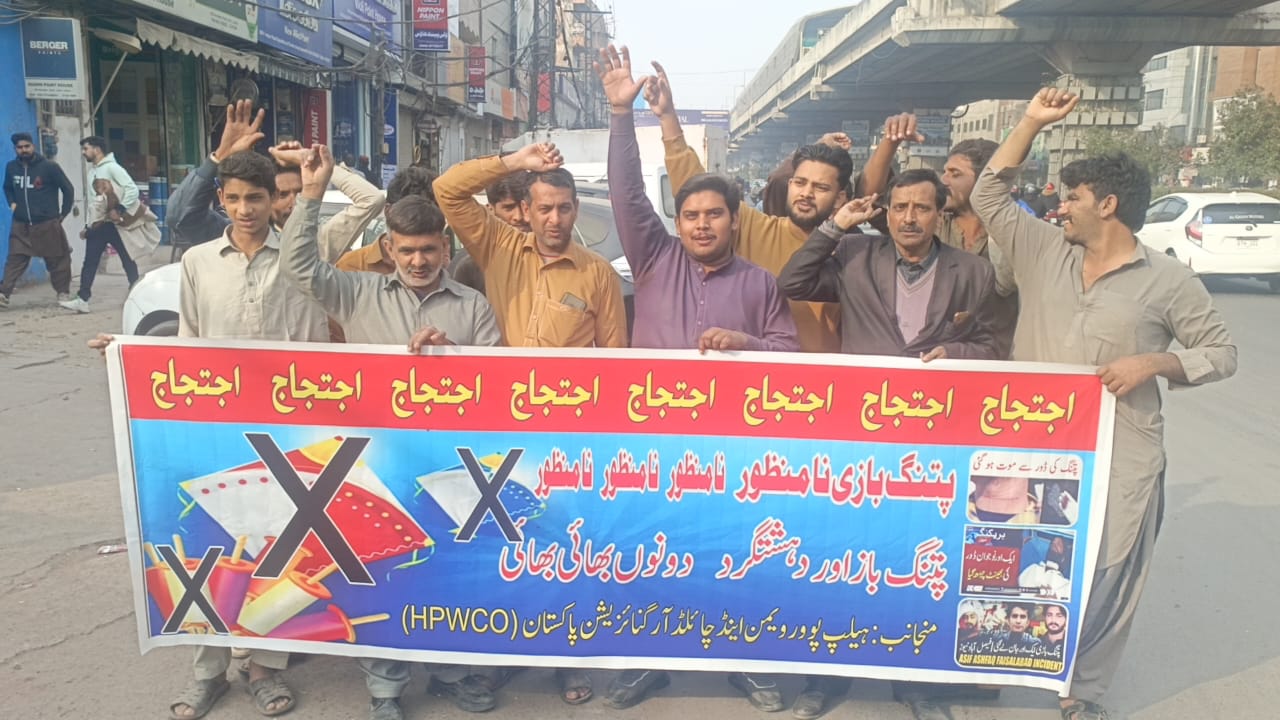
Strong public concern has emerged in Lahore against the government’s decision to allow kite flying, as civil society organizations and citizens warn that the activity poses a serious threat to human life. In this connection, Help Poor Women and Child Organization Pakistan organized a protest demonstration and media conference on Main Ferozepur Road near Ichhra Bazaar, in front of the LESCO Office, demanding an immediate and complete ban on kite flying.
The protest reflected growing anxiety among the public over the revival of kite flying, an activity that many believe has long crossed the boundary of a harmless cultural pastime and transformed into a dangerous and deadly practice. Protesters carried placards and banners highlighting the loss of innocent lives in the past due to hazardous kite strings, particularly metallic and glass-coated cords.
Concerns Over Public Safety
Addressing the gathering, Muhammad Ramzan Mayo, President of Help Poor Women and Child Organization Pakistan, expressed deep reservations over the government’s move to permit kite flying. He stated that kite flying can no longer be regarded as a recreational sport, as it has repeatedly resulted in fatal incidents and severe injuries, especially among pedestrians, motorcyclists, and children.
“Kite flying has become a life-threatening activity. In the past, when this practice was at its peak, hundreds of innocent citizens lost their lives due to metal and glass-coated strings,” he said. “These deaths were not accidents; they were the direct result of negligence and the unchecked use of dangerous materials.”
He emphasized that every life lost due to such activities is a collective failure of governance, regulation, and enforcement. According to him, reviving kite flying without foolproof safety guarantees is equivalent to placing human lives at risk.
Lack of Guarantees and Accountability
Muhammad Ramzan Mayo raised a critical question regarding accountability. He pointed out that even today, there is no credible mechanism to ensure that kite flyers will not use prohibited and hazardous strings.
“Who will take responsibility if another innocent citizen loses their life?” he questioned. “There is no guarantee that dangerous strings will not be used again. The past has already shown us the consequences.”
He further criticized what he described as the state’s apparent support or tolerance of elements that promote kite flying despite its deadly history. According to him, such an approach is not only irresponsible but also directly contradicts the state’s obligation to protect public safety.
“The support or patronage of those who promote this lethal activity is deeply regrettable and goes against the fundamental principle of safeguarding citizens’ lives,” he added.
Impact of Kite Flying on Women, Children, and the Poor
The protestors highlighted that women, children, and economically vulnerable citizens are often the worst affected by kite-related accidents. Many victims are daily wage earners or commuters who become casualties while simply going about their routine lives.
Motorcyclists, schoolchildren, and pedestrians are particularly exposed to the risk posed by sharp kite strings stretched across roads and streets. Several past incidents have resulted in permanent disabilities, severe injuries, and fatalities, leaving families devastated and without support.
“The emotional and economic cost borne by affected families is irreversible,” Muhammad Ramzan Mayo said. “No celebration or festival can justify the loss of a human life.”
Demand for Immediate and Permanent Ban
During the protest, the organization strongly urged the Punjab Government to reconsider its decision and impose an immediate, complete, and permanent ban on kite flying. The protesters stressed that partial permissions or temporary restrictions are insufficient and ineffective.
They demanded strict legal action against individuals involved in the manufacturing, sale, and use of metallic and glass-coated kite strings. According to the organization, enforcement agencies must be empowered and directed to act without discrimination to prevent illegal practices.
“The safety of citizens must take precedence over all other considerations,” the protest leaders stated. “Human life cannot be compromised for the sake of entertainment or commercial interests.”
Call for Responsible Governance
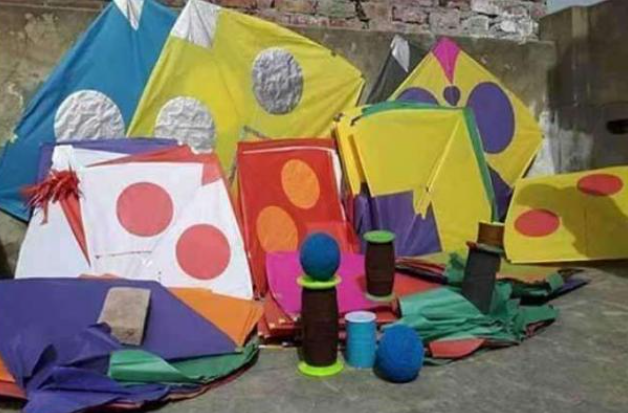
The protest also served as a call for responsible policymaking. Civil society representatives emphasized that decisions affecting public safety must be made after careful consideration of past experiences and ground realities.
They argued that instead of reviving hazardous activities, the government should focus on promoting safe recreational alternatives and strengthening enforcement against illegal practices that endanger lives.
Participants at the demonstration reiterated that governance is not merely about granting permissions but about ensuring the protection of life and property. They warned that ignoring public concerns could further erode trust between citizens and authorities.
Public Reaction and Growing Debate
The issue of kite flying has once again ignited a broader debate in Lahore and other urban centers of Punjab. While some view it as a cultural tradition, an increasing number of citizens and organizations argue that tradition cannot be defended when it consistently results in loss of life.
Social activists, parents, and community leaders have echoed similar concerns, urging authorities to learn from past tragedies and avoid repeating mistakes that have already cost too many lives.
Historical Background of the Kite Flying Ban in Punjab
The ban on kite flying in Punjab was not imposed arbitrarily; rather, it was the outcome of a painful history marked by repeated tragedies and public outcry. During the early and mid-2000s, kite flying—especially during Basant—became widespread across Lahore and other major cities. However, the unchecked use of metallic, nylon, and glass-coated strings (dor) turned this cultural activity into a deadly hazard.
-
2003–2005: Reports of fatal accidents caused by sharp, glass-coated and metallic kite strings began to increase significantly. Motorcyclists and pedestrians were among the most affected victims, suffering severe neck injuries.
-
February 2006: Several deaths were reported in Lahore during Basant celebrations, triggering widespread public outrage and media scrutiny. Hospitals recorded a sharp rise in emergency cases linked to kite strings.
-
2006–2007: In response to mounting casualties, the Punjab Government imposed a ban on kite flying, citing public safety concerns. During this period, the Lahore High Court also took notice of the matter, emphasizing the state’s responsibility to protect human life.
-
2007: The ban was strictly enforced, leading to the suspension of Basant celebrations in Lahore. Authorities also initiated crackdowns against the manufacturing and sale of metallic and chemical-coated kite strings.
-
2010–2015: Despite the ban, sporadic incidents continued due to illegal kite flying, reinforcing concerns that enforcement challenges alone could not eliminate the danger posed by hazardous kite strings.
-
2017: The Punjab government once again reaffirmed the ban on kite flying, declaring it a non-negotiable matter of public safety after fresh incidents of injuries and deaths were reported.
These historical developments clearly demonstrate that the ban on kite flying was not merely an administrative decision, but a response shaped by years of tragic experiences and judicial concern. For many citizens, each date associated with the ban represents lives lost and families shattered, making any relaxation of restrictions a deeply sensitive and controversial issue.
Conclusion
The protest organized by Help Poor Women and Child Organization Pakistan underscores a clear and urgent message: public safety must not be compromised under any circumstances. The demand for an immediate ban on kite flying reflects the collective pain of families who have lost loved ones and the fear of citizens who see history repeating itself.
As Lahore continues to grow as a bustling metropolis, ensuring the safety of its residents remains a fundamental responsibility of the state. Whether the authorities will heed this warning and take decisive action remains to be seen, but the voices raised on Main Ferozepur Road have made one thing clear — for many citizens, kite flying is no longer a celebration, but a preventable threat to human life.
Muhammad Iqbal Harper is a Lahore-based senior journalist, covering civic, social, and public policy issues. He is also President of the Pakistan Sports Journalists Federation.