
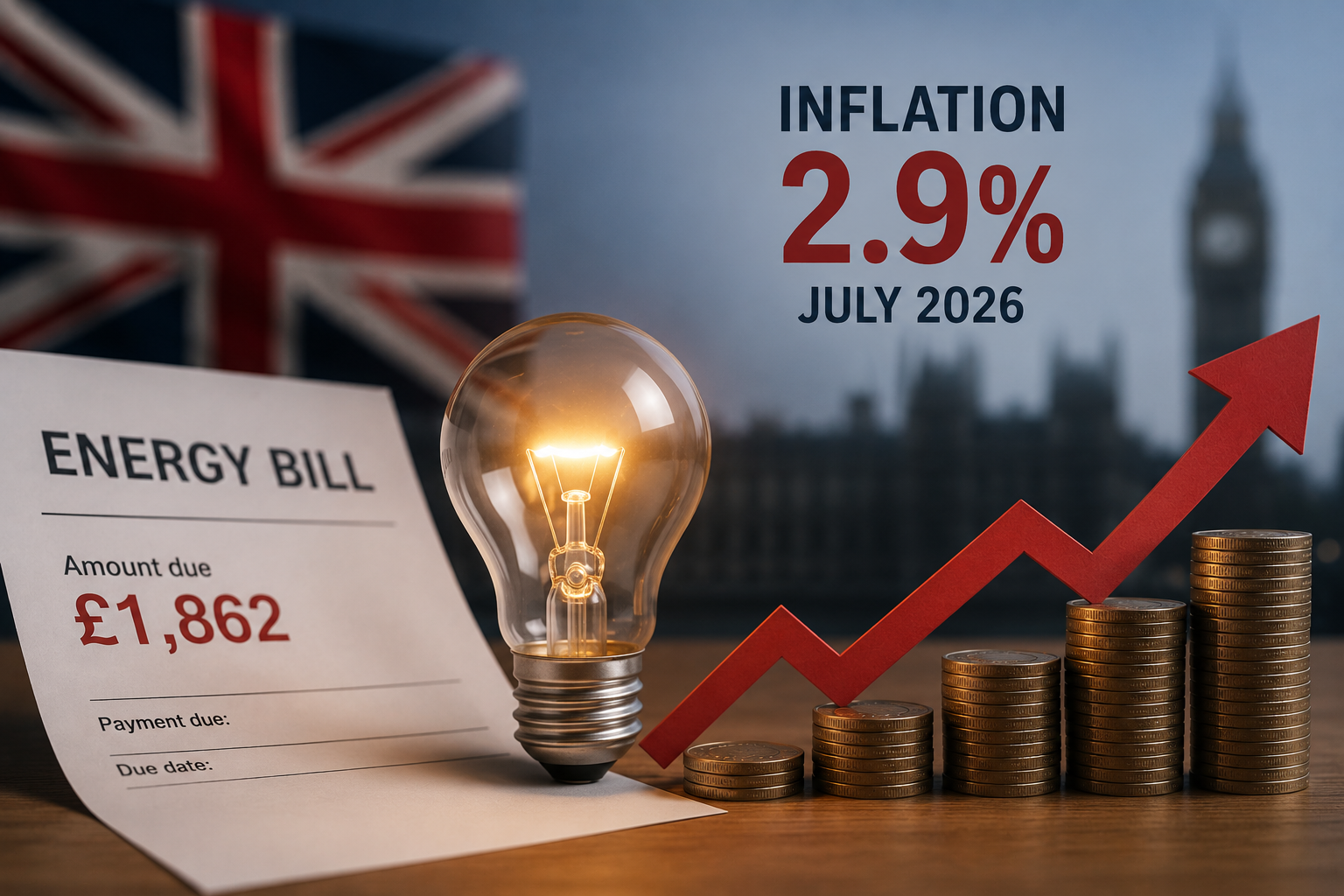
UK inflation accelerated to 2.9% in July 2026, up from 2.6% in June, as higher household energy costs added to pressure on consumers and the wider economy.
The increase followed a 13% rise in the energy price cap that took effect on July 1 for households on default tariffs in Great Britain. The regulator Ofgem said the higher cap reflected increased wholesale gas costs linked to continuing instability in the Middle East.
The latest UK inflation figures were released by the Office for National Statistics (ONS) on Aug. 19. The increase puts inflation further above the Bank of England’s 2% target and highlights the continuing effect of global energy market volatility on British households.
For Pakistan and other energy-importing economies, the developments in Britain also illustrate how geopolitical tensions and movements in international energy markets can quickly translate into higher household and business costs.
UK Inflation Driven Higher by Energy Costs
The main pressure behind the July increase was the higher cost of domestic energy.
Ofgem raised the price cap by 13% for the period from July 1 to Sept. 30. The cap applies to default tariffs and limits the maximum unit rates and standing charges suppliers can apply to customers.
Under the regulator’s revised figures, the annual price cap for a typical household paying by direct debit rose to £1,862, compared with £1,641 under the previous calculation. Ofgem said this represented an increase of £221, or 13%, under the consumption assumptions then used.
Electricity prices also increased, although by less than gas prices. The average electricity unit rate for direct-debit customers increased from 24.67 pence per kilowatt-hour to 26.11 pence, while the average gas rate rose from 5.74 pence to 7.33 pence per kilowatt-hour.
Ofgem said wholesale gas prices were a major factor behind the increase.
The regulator noted that the July rise differed from the energy crisis of 2022 because electricity prices were being affected less severely than gas prices. Greater renewable generation has reduced the UK’s reliance on gas for electricity production, according to Ofgem.
The regulator also said about 40% of energy accounts, representing roughly 22 million accounts, were on fixed tariffs and therefore were not directly affected by the July price-cap change.
Global Energy Volatility Adds to Cost-of-Living Pressure
The increase in UK inflation comes against the backdrop of continuing conflict and uncertainty in the Middle East.
 Energy markets are particularly sensitive to geopolitical developments because disruptions to oil and gas supplies can affect wholesale prices well beyond the immediate conflict zone.
Ofgem said in May that the July price-cap increase was driven by higher wholesale gas prices associated with the continuing conflict in the Middle East.
The Bank of England has also acknowledged the inflationary risks created by the energy shock.
In its July Monetary Policy Report, the central bank said crude and refined energy prices had remained volatile and above pre-conflict levels. It warned that the impact on the British economy remained uncertain and that higher energy prices were expected to feed into UK inflation later in the year.
The effect is not limited to electricity and gas bills.
Higher energy costs can increase expenses for businesses, transport operators, manufacturers and service providers. Companies may subsequently pass part of those costs to consumers through higher prices.
That creates the risk of broader inflationary pressure even when the original shock comes from the energy market.
Bank of England Faces Difficult Policy Balance
The latest inflation reading presents a challenge for the Bank of England.
The central bank’s monetary policy committee voted 6-3 in July to keep Bank Rate at 3.75%. Three members preferred a quarter-point increase to 4%.
Higher interest rates can help contain inflation by reducing demand, but they cannot directly lower global gas or oil prices.
The Bank of England has therefore faced a difficult balance between preventing temporary energy-driven inflation from becoming embedded in wages and prices and avoiding unnecessary pressure on economic growth.
A Reuters poll conducted in August found that most economists expected the Bank of England to leave its benchmark interest rate unchanged for the remainder of 2026 despite concerns about rising UK inflation.
The situation could change if higher energy costs begin producing stronger second-round effects across the economy.
Government Looks to Ease Household Costs
The British government has faced growing pressure to limit the impact of higher household expenses.
Prime Minister Andy Burnham’s administration has introduced measures aimed at reducing living costs, including a cut in VAT on electricity bills and measures to limit bus fares. The government has also been considering further assistance for households facing higher energy costs.
Chancellor John Healey, who took charge of the Treasury in July, faces the task of balancing support for households with Britain’s wider fiscal constraints.
 Healey was appointed Chancellor of the Exchequer on July 20, 2026, after previously serving as defence secretary. The Treasury describes the chancellor as responsible for fiscal policy, taxation, public spending and the government’s economic growth strategy.
The UK inflation increase is likely to remain an important issue ahead of the government’s next major budget decisions.
Economists have also warned that another increase in household energy costs could place additional pressure on UK inflation later in the year.
Implications for the UK and Global Economy
The latest figures demonstrate how closely domestic inflation can be connected to international energy markets.
Britain’s experience is particularly relevant for countries that depend significantly on imported energy. When wholesale prices rise, governments may face a difficult choice between allowing higher costs to reach consumers or using public funds and tax measures to cushion households.
For Pakistan, the issue carries particular relevance because fluctuations in global oil and gas prices can affect electricity generation costs, transport expenses, inflation and the country’s import bill.
A prolonged period UK inflation in the form of elevated international energy prices could therefore create pressure on governments across emerging economies, particularly those already managing fiscal and external-account constraints.
At the same time, Britain’s experience highlights the economic value of reducing dependence on volatile fossil-fuel markets. Ofgem has pointed to increased renewable electricity generation as one factor helping to limit the impact of higher gas prices on electricity costs.
For policymakers, the UK inflation challenge is not simply to respond to the next price shock but to improve energy resilience over the longer term.
Uncertain Situation due to persistent energy-market volatility
The rise in UK inflation to 2.9% in July reflects the continuing impact of higher energy costs on British households and the broader economy. The 13% increase in Ofgem’s energy price cap from July was a major factor behind the renewed inflationary pressure.
While the British economy has shown resilience, persistent energy-market volatility could complicate efforts to bring UK inflation back to the Bank of England’s 2% target.
The developments also carry wider lessons for energy-importing countries. Diversifying energy supplies, expanding renewable generation and protecting vulnerable households could become increasingly important as geopolitical tensions continue to influence global energy markets.
#UKInflation, #EnergyBills, #UKEconomy, #CostOfLiving, #EnergyPrices, #Inflation2026, #BritainEconomy, #GlobalEnergy, #MiddleEastConflict, #JohnHealey

Dr. H. Zafar is a distinguished writer and analyst associated with Press Network of Pakistan as Associate Editor. With a strong academic background and years of research experience, she brings depth, clarity, and analytical rigor to her writings.