By Usman Shahid
Pakistan’s climate argument is easy to understand, but hard to finance.
The country contributes less than one percent of global greenhouse gas emissions, but it keeps paying for disasters. The 2022 floods remain the clearest example. They killed more than 1,700 people and affected 33 million. Estimated direct damages were $15.2 billion in economic losses, and $16.3 billion in recovery and reconstruction needs. That is why Pakistan talks about climate justice. But climate finance does not move on justice alone. It moves through project documents, debt checks, ministries, procurement rules, donor confidence etc. That is where Pakistan’s case becomes weaker than its moral argument.
South Africa understood this earlier than most countries. At COP26, it secured the first Just Energy Transition Partnership (JETP), from France, Germany, the United Kingdom, the United States and the European Union. The initial pledge was $8.5 billion. The deal was not charity in the usual sense rather it was built around a clear bargain: South Africa would accelerate its move away from coal, while donors would help finance renewable energy, grid expansion, coal-plant repurposing and support for workers and communities affected by the transition.
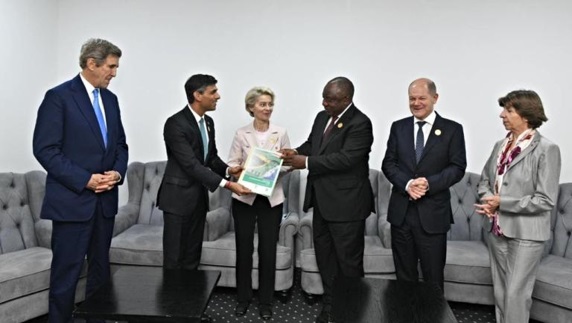
Source: President Cyril Ramaphosa and the International Partners Group at the JET Investment Plan meeting on the sidelines of COP27. Photo: @PresidencyZA/Twitter ( Courtesy: Peoples Dispatch )
It was not perfect. South Africa still says it needs far more money than the JETP provides. It has also struggled with electricity shortages, old coal plants, politics around jobs and delays in turning pledges into actual projects. But it had one thing Pakistan still lacks: a transition story that donors could understand. Pakistan does not yet have a JETP-style story. It has climate vulnerability, we know also it has floods, heatwaves, glacial risks and smog. It has a overall strong claim for adaptation finance. But a JETP is not mainly an adaptation deal. It is an energy-transition bargain which is usually built around coal retirement, power-sector reform, a credible investment plan and that is difficult for Pakistan.
Pakistan’s coal fleet is newer than South Africa’s. Several large coal power plants were built in the last decade also many are linked to CPEC and long-term power purchase agreements. So, retiring them early is not simply a climate decision; it is also a debt, contract, capacity-payment and diplomacy problem. Unlike South Africa, Pakistan has not placed a clear coal-retirement timeline on the table and without that, donors have less to finance, and less to claim as an emissions-reduction result.
The second problem is institutional. Climate finance in Pakistan is scattered across too many desks. The Ministry of Climate Change may carry the climate file, but energy sector is different, finance is different, planning and provincial implementation are different as well. So, a JETP-sized package would require all of them to move together. Pakistan’s experience with the Green Climate Fund shows both the opportunity and the weakness. Pakistan has 11 GCF projects worth about $332 million, including work on glacial flood risk, climate-resilient agriculture, Karachi’s Green BRT, distributed solar, and Recharge Pakistan. But compared with Pakistan’s needs, that is still small.
The third problem Is trust. International lenders look at Pakistan through the lens of debt stress, IMF conditions, circular debt in the power sector, weak tax capacity and repeated implementation delays. Pakistani officials can say, that the country needs grant-based climate finance, not more loans. But donors still ask the next question: where is the project pipeline, who will implement it, what will be retired or built, and how will progress be verified?
I would say Pakistan has started moving in that direction, but not yet at JETP scale. Finance Minister Muhammad Aurangzeb has formally sought about $1 billion from the IMF’s Resilience and Sustainability Trust. That is a facility meant for climate resilience and cleaner-energy transition. That matters because it shows the finance ministry is no longer treating climate only as an environment issue. But an IMF climate facility is not the same as a JETP. It is still financing inside a debt program, it is not a political bargain with rich countries to restructure the energy transition.
For Pakistan, the more realistic question is not, “Do we deserve a JETP?” I believe we should focus on “Can we design something like that?”
A Pakistan JETP would have to look different from South Africa’s. It could not only be about closing old coal plants, because Pakistan’s coal problem is newer and contract-heavy. It would need to include power-sector reform, grid upgrades, industrial energy efficiency, distributed solar, battery storage, flood-resilient infrastructure, and just-transition support for workers in coal, textiles, transport and informal industry. It would also need one national investment plan that donors, provinces and private investors can read without confusion.
Usman Shahid Warraich is a scholar of international relations with a keen interest in climate security, environmental geopolitics and global climate governance. Their writing focuses on how climate change reshapes strategic vulnerabilities in the developing world, with a particular focus on Pakistan. Usman.shahid83@ucp.edu.pk
Naeem Akhtar plays a key role in shaping editorial content and maintaining the highest standards of accuracy and clarity. His dedication ensures that PNP’s coverage remains timely, reliable, and impactful for its readers worldwide.