In times of military tension, the name of an operation often carries meaning beyond the battlefield. During the recent escalation between Pakistan and Afghanistan, the Pakistan Army launched Operation “Ghazab Lil Haq” (غضب للحق) — a title that quickly drew public attention not only for its military implications but also for its linguistic and symbolic depth.
Across social media, many Pakistanis asked: What does Ghazab Lil Haq actually mean? Why are such names chosen? And how do they reflect Pakistan’s broader military narrative?
Let’s explore the evolution of English and Arabic military operation names used by the Pakistan Army, their meanings, and the strategic messaging behind them.
Operation Ghazab Lil Haq (غضب للحق)
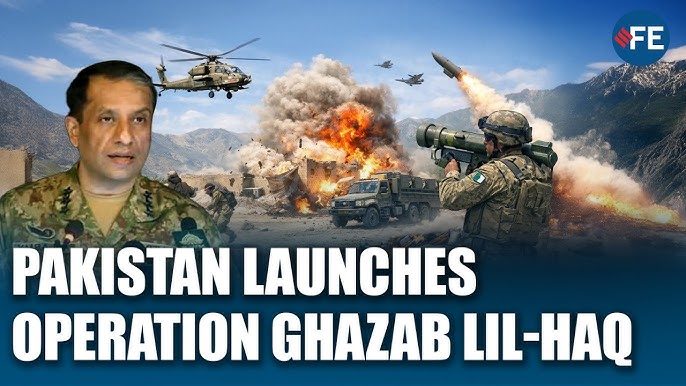
The recent cross-border tensions with Afghanistan prompted Pakistan to initiate Operation Ghazab Lil Haq, officially described as a response to “unprovoked aggression.”
From a linguistic perspective, the phrase is Arabic and can be divided into three components:
-
Ghazab (غضب) – intense anger, powerful reaction, or righteous wrath
-
Lil (لِل) – meaning “for” or “for the sake of”
-
Haq (حق) – truth, justice, or legitimate right
Combined, Ghazab Lil Haq literally translates to “Wrath for the Truth” or more accurately, “Righteous Anger for Justice.”
In Islamic and Arabic tradition, the word ghazab is not necessarily negative. It is often used in moral or religious contexts to describe a justified reaction in defense of truth. The phrase therefore conveys that the action is being framed not as aggression, but as a defense of legitimate rights.
This reflects a long-standing tradition in Pakistan’s military history: the deliberate selection of operation names that project moral legitimacy and ideological clarity.
Arabic Tradition in Pakistan Military Operation Names
Over the past two decades, Arabic terminology has dominated major military campaigns. These names often carry religious, moral, or symbolic undertones, giving operations a deeper narrative context.
Below are some of the most prominent examples.
Operation Zarb-e-Azb
Launched in 2014 against militant groups in North Waziristan, Zarb-e-Azb became one of the most significant military campaigns in Pakistan’s history.
-
Zarb (ضرب) means “strike” or “blow.”
-
Azb (عضب) is traditionally believed to be the name of the sword of Prophet Muhammad (PBUH).
The phrase symbolically translates to “Sharp and Cutting Strike by the Holy Sword.”
The name conveyed decisiveness and moral authority. It framed the operation as a final, determined blow against terrorism, reinforcing public confidence in the state’s resolve.
Operation Radd-ul-Fasaad
-
Radd (رد) means “rejection” or “eradication.”
-
Fasaad (فساد) means “chaos,” “corruption,” or “disorder.”
The full meaning is “Elimination of Discord” or “Rejection of Chaos.”
Here again, Arabic terminology framed the mission in ethical terms: the state acting to remove corruption and restore peace.
Operation Bunyan-um-Marsoos
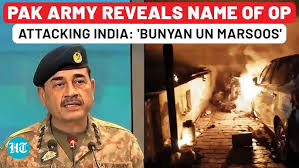
During heightened tensions with India, Pakistan named one of its defensive postures Bunyan-um-Marsoos.
The phrase comes from a Quranic verse describing believers standing united “like a solid wall cemented with molten lead.”
-
Bunyan (بنيان) – structure or foundation
-
Marsoos (مرصوص) – solidly joined, reinforced
It translates to “A Solid Unconquerable Wall.”
The symbolism here emphasized unity, strength, and collective resolve.
The English Exception: Operation Swift Retort
The phrase means “Quick and Immediate Response.”
This operation followed India’s air intrusion, and during the engagement, Indian pilot Abhinandan Varthaman was captured.
Why was this name in English?
Analysts suggest that this reflected the international nature of the crisis. By choosing an English title, Pakistan may have been addressing a global diplomatic audience, signaling professionalism, proportionality, and strategic restraint rather than ideological framing.
Interestingly, both Operation Swift Retort (2019) and Operation Ghazab Lil Haq were initiated on February 27 — a date that now holds symbolic military significance in Pakistan’s recent history.
Why Arabic Dominates Pakistani Military Operation Names
A review of the past twenty years shows a clear pattern: Arabic names are preferred for large-scale internal security and counterterrorism campaigns in Pakistan.
This linguistic preference is not accidental. It reflects strategic, cultural, and psychological considerations. Below are five key reasons explaining why Arabic dominates Pakistan’s military operation titles.
1. Moral Framing and Ethical Legitimacy
Arabic terminology often carries deep religious and ethical connotations. Words such as Haq (truth/justice), Fasaad (corruption/chaos), or Zarb (strike) are not merely descriptive; they are value-laden.
By choosing Arabic phrases, operations are framed as morally justified actions rather than purely tactical maneuvers. The language subtly communicates that the mission is rooted in the defense of justice, stability, and righteousness.
This moral framing strengthens the state’s narrative that military action is reactive and principled — not aggressive.
2. Public Mobilization and Cultural Resonance
Pakistan’s social fabric has strong cultural, religious, and historical ties to Arabic vocabulary. Even citizens who do not formally speak Arabic recognize key religious terms and understand their significance.
Operation names drawn from Arabic therefore resonate deeply with the public. They create a sense of shared purpose and unity, particularly during times of national crisis.
Such names foster emotional engagement and strengthen national solidarity behind military campaigns.
3. Psychological and Strategic Messaging
Operation names are part of strategic communication. They signal intent — to domestic audiences, adversaries, and international observers alike.
Arabic names often project firmness, ideological clarity, and unwavering resolve. They send a message that the action is not temporary or symbolic but rooted in principle.
For adversaries, the tone can imply determination and seriousness. For allies and domestic audiences, it reinforces legitimacy and confidence.
4. Historical and Institutional Continuity
Over time, Arabic naming has become an institutional tradition within Pakistan’s military doctrine. Major campaigns such as Zarb-e-Azb and Radd-ul-Fasaad established a precedent that later operations followed.
Maintaining this tradition ensures continuity in military branding. It connects current campaigns to past successes, creating a sense of ongoing national struggle against instability and extremism.
This continuity strengthens institutional identity and reinforces the narrative of long-term strategic consistency.
5. Symbolic Power and Ideological Clarity
Arabic as a language carries symbolic authority in the broader Muslim world. Its vocabulary is closely associated with scripture, scholarship, and classical heritage.
Using Arabic terminology adds symbolic weight to military campaigns. It frames operations within a broader ideological and civilizational context rather than limiting them to geographic or tactical objectives.
In this sense, the language amplifies the symbolic power of the operation — presenting it as part of a larger moral struggle rather than a narrow military engagement.
Language as Strategic Communication
Military naming conventions are a subtle yet powerful communication tool. The choice between Arabic and English reflects the intended audience and geopolitical context.
-
Arabic names emphasize moral legitimacy and ideological clarity.
-
English names signal professionalism, global messaging, and diplomatic calibration.
Operation Ghazab Lil Haq fits squarely within the Arabic tradition. Its meaning — “Righteous Anger for Justice” — conveys that the action is presented as defensive rather than aggressive.
This linguistic framing is consistent with past operations where the emphasis was on eliminating chaos (Radd-ul-Fasaad) or delivering a decisive blow (Zarb-e-Azb).
A Pattern Over Two Decades
If we analyze major Pakistan Army operations from 2001 onward, a clear trend emerges:
-
Arabic names dominate counterterrorism and internal security campaigns.
-
English names are rare and typically associated with interstate conflicts or international crises.
This pattern suggests deliberate strategic branding rather than coincidence.
Conclusion: Beyond the Battlefield
In modern warfare, words matter almost as much as weapons — and in Pakistan’s case, those words are often chosen with deep cultural and strategic calculation. Operation Ghazab Lil Haq continues this legacy — reinforcing the message that actions taken are framed as defense of justice rather than acts of aggression.
While English, despite having the status of international language, has occasionally been used — particularly in interstate crises where international messaging was prioritized — Arabic remains dominant in internal security and counterterrorism contexts.
This dominance reflects not just tradition, but a deliberate communication strategy. Operation names are not merely administrative labels. They are narratives. From Zarb-e-Azb to Radd-ul-Fasaad, from Bunyan-um-Marsoos to Swift Retort, Pakistan’s military naming tradition reflects a blend of symbolism, faith, national resolve, and strategic communication.
As history shows, the language of warfare is not only spoken through weapons but also through words. In Pakistan’s case, those words often carry centuries of linguistic, cultural, and moral weight.
In the evolving security landscape, names remain part of psychological strategy — shaping perception, consolidating unity, and projecting moral strength both at home and abroad. Through such powerful titles, Pakistani military shapes perception, builds legitimacy, and reinforces national unity.
Mr. Sabahuddin Qazi is a senior researcher and analyst based in Islamabad.