In a landmark decision that signals Pakistan’s commitment to the digital future, the Higher Education Commission (HEC) Pakistan has directed all public and private universities to introduce a mandatory 3-credit hour course on Artificial Intelligence (AI education) across all undergraduate and postgraduate degree programs starting from Fall 2026.
This transformative step reflects the growing global recognition that AI is no longer a specialized subject limited to computer science departments. Instead, it has become a foundational tool reshaping education, healthcare, business, governance, engineering, media, and nearly every sector of society.
A Strategic Move for Pakistan’s Future
Artificial Intelligence is rapidly redefining how knowledge is created, processed, and applied. From predictive healthcare systems to automated financial analytics, AI is driving innovation at an unprecedented pace. Recognizing this global shift, HEC has moved proactively to ensure that Pakistani graduates are not left behind in the emerging AI-driven economy.
The directive emphasizes that integrating AI into curricula is not merely an academic enhancement — it is a necessity of the time. Students without a foundational understanding of AI risk falling behind in a global knowledge economy that increasingly demands digital literacy, adaptability, and technological competence.
By making AI education compulsory, HEC is aligning Pakistan’s higher education framework with international academic standards and workforce requirements.
What the Mandatory AI Course Will Cover
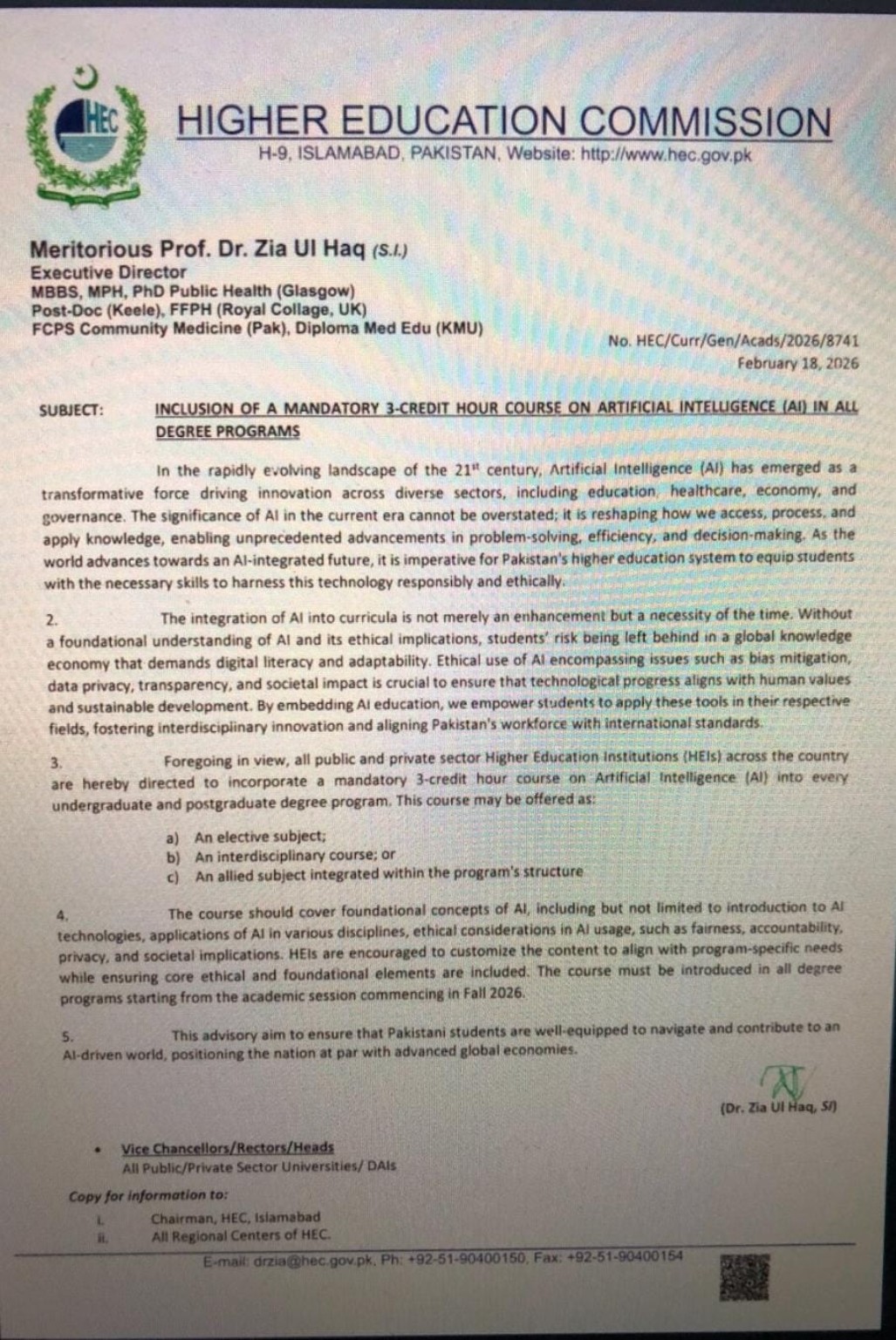
According to the advisory, the 3-credit hour AI course must include:
-
Introduction to AI technologies and concepts
-
Applications of AI in various disciplines
-
Ethical considerations including fairness, accountability, and transparency
-
Data privacy and bias mitigation
-
Societal implications of AI
-
Responsible and ethical use of AI systems
Importantly, Higher Education Institutions (HEIs) are encouraged to customize course content to suit discipline-specific needs while ensuring that core foundational and ethical elements remain intact.
This flexibility allows medical students, for example, to focus on AI in diagnostics and healthcare analytics, while business students may explore AI-driven financial modeling, marketing analytics, and decision support systems. Engineering students can examine robotics and machine learning applications, while social sciences students can analyze AI’s societal and governance impacts.
Why Ethical AI Education Matters
One of the most significant aspects of this policy is its emphasis on ethics. Around the world, debates about AI bias, misinformation, privacy violations, and algorithmic discrimination are intensifying. The HEC directive highlights fairness, accountability, transparency, and societal impact as essential components of AI education.
This approach demonstrates foresight. Teaching AI without ethical grounding can create technologists who innovate without considering consequences. However, embedding ethical frameworks ensures that future professionals use AI responsibly and in alignment with human values and sustainable development goals.
Pakistan’s decision to prioritize ethical AI education places it among responsible nations preparing students not just to use AI tools — but to use them wisely.
Bridging the Digital Skills Gap
The global economy is rapidly transitioning toward automation and intelligent systems. Reports consistently show that AI literacy will soon become as fundamental as basic computer skills.
For Pakistan, where youth constitute a significant proportion of the population, this initiative can be transformative. By equipping graduates across disciplines with AI knowledge, the country strengthens its human capital and enhances employability at both national and international levels.
The integration of AI into all degree programs will:
-
Improve workforce competitiveness
-
Foster innovation and entrepreneurship
-
Encourage interdisciplinary collaboration
-
Attract international academic and research partnerships
-
Boost Pakistan’s position in the global knowledge economy
In essence, AI education becomes not just a subject — but a strategic economic investment.
Flexibility in Implementation
The HEC has provided universities with three implementation options:
-
Offer AI education as an elective subject
-
Introduce it as an interdisciplinary course
-
Integrate it as an allied subject within existing program structures
This flexible approach respects institutional autonomy while ensuring uniform nationwide adoption.
By Fall 2026, every degree program in Pakistan — whether in arts, sciences, commerce, medicine, engineering, or humanities — must include this AI component.
Such a comprehensive directive reflects a nationwide vision rather than a limited academic reform.
Preparing Students for an AI-Driven World
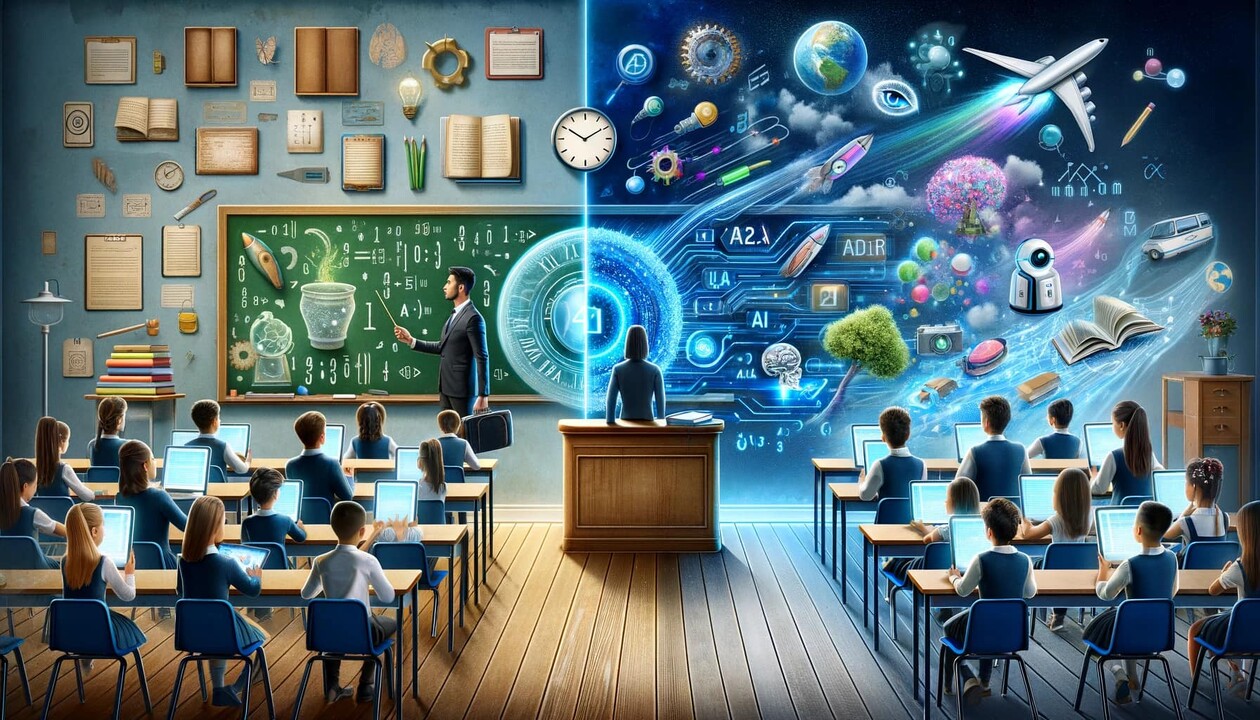
The 21st century is increasingly defined by intelligent automation. AI assists doctors in diagnosing diseases, supports governments in policymaking, powers smart cities, enhances cybersecurity, drives e-commerce personalization, and even contributes to climate modeling.
Without AI education, graduates risk becoming passive consumers of technology rather than active innovators.
This policy ensures that Pakistani students will understand:
-
How AI systems work
-
Their limitations and risks
-
Their transformative potential
-
Their ethical and societal responsibilities
By doing so, Pakistan is nurturing not only AI users — but future AI developers, regulators, researchers, and thought leaders.
National Development Through Digital Transformation
Pakistan has consistently emphasized digital transformation through initiatives promoting IT exports, freelancing, fintech, and startup ecosystems. However, sustainable digital growth requires strong academic foundations.
Making AI education mandatory institutionalizes this transformation. It ensures that digital literacy is not confined to urban tech hubs but becomes embedded across the country’s academic infrastructure.
Furthermore, this decision signals to global investors and international academic partners that Pakistan is serious about participating in the Fourth Industrial Revolution.
Challenges and the Way Forward
While the decision is visionary, effective implementation will require:
-
Faculty training and upskilling
-
Curriculum development support
-
Updated laboratory and computing infrastructure
-
Access to AI tools and platforms
-
Collaboration with industry and technology experts
Universities must now invest in capacity building to ensure the course goes beyond theoretical lectures and includes practical exposure.
Partnerships with technology companies, research institutions, and startups can further strengthen course quality and relevance.
If implemented effectively, this initiative could mark one of the most impactful educational reforms in Pakistan’s recent history.
A Transformative Milestone
The Higher Education Commission’s directive is more than a curriculum update. It is a declaration that Pakistan intends to prepare its youth for the realities of the modern world.
In a time when AI is reshaping economies and redefining human potential, proactive education policy becomes a national imperative.
By embedding AI education across all disciplines, Pakistan is taking a decisive step toward:
-
Digital empowerment
-
Ethical technological advancement
-
Global competitiveness
-
Sustainable national growth
As Fall 2026 approaches, universities across the country will begin adapting to this transformative mandate. The success of this initiative of AI education will depend on collective effort — from policymakers and educators to students and industry leaders.
One thing is certain: the future belongs to those who understand and responsibly harness Artificial Intelligence. Through this bold move, Pakistan is ensuring that its students are ready not just to witness that future — but to shape it.

Dr. H. Zafar is a distinguished writer and analyst associated with Press Network of Pakistan as Associate Editor. With a strong academic background and years of research experience, she brings depth, clarity, and analytical rigor to her writings.