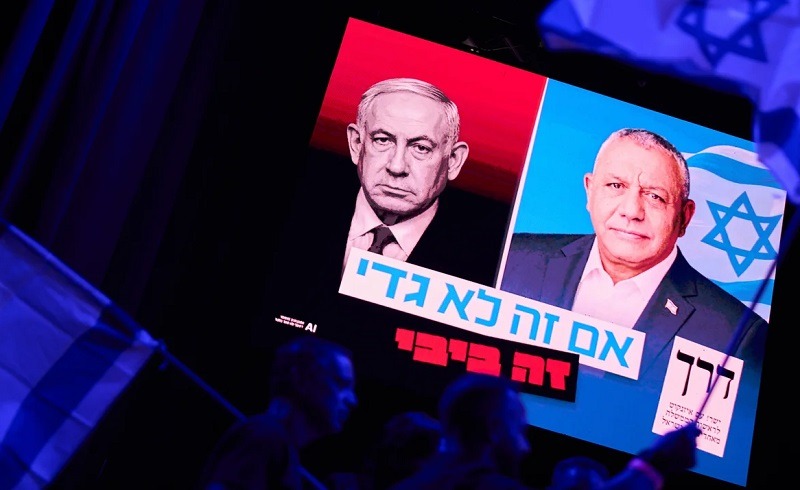
TEL AVIV: Israel’s parliamentary elections have produced a close contest between Prime Minister Benjamin Netanyahu’s alliance and the opposition bloc led by Gadi Eisenkot, with early exit polls suggesting that neither side is on course to secure a clear majority.
According to preliminary exit polls, two surveys indicate a neck-and-neck race between Eisenkot’s opposition alliance and Netanyahu’s camp, while a third poll gives Netanyahu’s alliance a narrow lead.
Despite the varying projections, both camps appear to be short of the majority required to form a government in parliament.
Gadi Eisenkot, leader of the opposition’s “Change Bloc,” heads the newly established Yashar Party. The opposition parties within the alliance share the common objective of removing Netanyahu from power.
Meanwhile, exit polls suggest that Netanyahu’s Likud Party is emerging as the largest single party in the Israeli parliament.
Elections were held for all 120 seats in Israel’s parliament, known as the Knesset. No single party has historically managed to secure a clear majority on its own, making coalition-building essential for forming a government.
Even a difference of a few seats in the final results could determine which side succeeds in forming the next government.
Given that exit polls have been inaccurate in previous elections, the preliminary projections are not being treated as a final verdict. The announcement of official results began around midnight local time, although the complete counting process could take several days.
According to a reporter based in Tel Aviv, political negotiations to form a government could continue for weeks or even months following the election. Various coalition arrangements and power-sharing possibilities are expected to be considered by the competing parties.
These are Israel’s first parliamentary elections since the Hamas-led attacks on Israel on October 7, 2023. The outcome is being viewed as crucial not only for Netanyahu’s political future but also for the formation of Israel’s next government and the direction of the country’s future policies.
Naeem Akhtar plays a key role in shaping editorial content and maintaining the highest standards of accuracy and clarity. His dedication ensures that PNP’s coverage remains timely, reliable, and impactful for its readers worldwide.