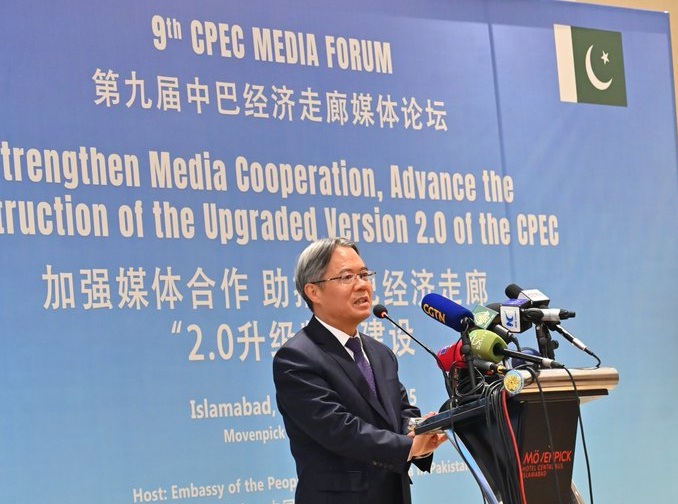
The 9th China-Pakistan Economic Corridor (CPEC) Media Forum in Islamabad emerged as a defining moment in the evolution of the Pakistan-China partnership, not merely as an economic initiative but as a geopolitical narrative battleground. Addressed by Chinese Ambassador to Pakistan, H.E. Jiang Zaidong, the speech highlighted how the CPEC, media and public discourse are central to shaping perceptions around CPEC and reinforcing bilateral ties.
Let’s analyze the core themes, diplomatic subtext, and media implications of the Ambassador’s address, and consider its significance for regional cooperation and global communication strategies.
1. Defending Narrative: CPEC 2.0 Against Misrepresentation
A central pillar of Ambassador Jiang’s speech was the reaffirmation of CPEC’s accomplishments and the need to defend its narrative against misinformation. Since its inauguration alongside President Xi Jinping’s historic visit in 2015, CPEC has grown beyond infrastructure to symbolize the broader Belt and Road Initiative (BRI).
Jiang underscored that the CPEC Media Forum serves as an influential platform for bilateral media cooperation, “creating a favorable public opinion environment” and making CPEC tangible through storytelling. At a time when disinformation campaigns — particularly around allegations such as the so-called “debt trap” — persist globally, the Ambassador emphasized the importance of fact-based reporting to counter distortions with data and narratives that reflect reality.
This strategy is not defensive alone; it is a proactive effort to build a global communication matrix that bridges understanding between China, Pakistan, and international audiences. The establishment of initiatives like the Golden Anchor Award for CPEC Communication and journalist fellowship programs points to institutionalized mechanisms for strengthening accurate, impactful CPEC media coverage.
2. Media as a Strategic Actor and Diplomatic Tool
Ambassador Jiang’s citation of the old adage about the sword and the pen was a deliberate appeal to journalists to view their role not simply as reporters but as strategic partners in CPEC’s evolution.
This metaphor reflects a broader shift in diplomacy: media practitioners are not peripheral observers but active participants shaping bilateral cooperation and public perception. In an era where digital platforms can amplify misinformation rapidly, the Forum called on media professionals to act as interpreters of development, communicators of CPEC outcomes, and promoters of Sino-Pak friendship.
The speech also reflected deeper diplomatic signaling: By aligning media with state goals, China and Pakistan aim to cultivate shared narratives that reinforce sovereignty, mutual respect, and strategic alignment. For example, Pakistan’s support for China’s territorial integrity — such as on the One-China policy and opposition to attempts to split Taiwan — was reiterated in the same forum context, spotlighting how media discourse and foreign policy priorities intersect.
3. Geopolitical Context and Strategic Messaging
Beyond the CPEC media strategy, Jiang’s speech implicitly conveyed broader geopolitical themes:
a. Countering Regional and Global Pressures
At the Forum, the Ambassador spoke out against what he framed as external narratives aimed at undermining CPEC and China-Pakistan cooperation, thus reinforcing strategic unity in the face of geopolitical contestation.
By connecting CPEC’s narrative defense with countering misinformation, the speech suggested a conscious effort to navigate international skepticism — including concerns raised by global commentators about debt, regional influence, or security implications.
b. Strengthening All-Weather Strategic Partnership
Reaffirming shared goals for CPEC Phase 2.0, Jiang highlighted priority areas such as agriculture, mining, and industry that will generate employment and enhance economic self-reliance.
This focus signals a pivot from infrastructure to economic integration and livelihood enhancement, aligning with both nations’ domestic development agendas.
c. Shared Public Diplomacy and Cultural Connectivity
Another layer of the speech was emphasis on people-to-people ties, which helps transform CPEC from a policy objective into a shared narrative of interdependence and friendship. Journalists are encouraged to narrate stories that resonate not just statistically but emotionally, fostering societal consensus around the partnership.
4. CPEC Media Cooperation: Practical Frameworks and Initiatives
The CPEC Media Forum’s agenda and Ambassador Jiang’s speech went beyond platitudes, outlining specific mechanisms for media engagement:
-
Golden Anchor Awards to recognize excellence in CPEC communication.
-
Journalist Fellowship Programs for sustained exchange and professional development.
-
Calls for joint fact-checking platforms and rapid response networks to tackle misinformation immediately.
These initiatives aim to professionalize and institutionalize narrative cooperation. For journalists, this creates not just access but responsibility — to deepen understanding of complex projects and counter narratives that oversimplify or distort mutual commitments.
5. Economic Indicators and Diplomatic Optimism
In addition to CPEC media strategy, Ambassador Jiang linked positive economic indicators to the narrative imperative. Citing China’s resilience and innovation in global markets and Pakistan’s improving economic metrics — including GDP growth and foreign exchange reserves — he framed CPEC as part of a broader success story for both nations.
This integration of economic data into media discourse serves a dual purpose: justifying strategic cooperation and instilling confidence among stakeholders — from business leaders to citizens.
6. Critical Perspectives and Future Challenges
While Ambassador Jiang’s speech presented a unified, optimistic narrative, several broader questions merit deeper reflection by media and policy analysts:
a. Balancing National Interests and Narrative Sovereignty
Framing CPEC media cooperation as a cornerstone of the mega project success risks blurring lines between journalism and policy advocacy. Media independence is crucial for credibility, and managing this balance will be a nuanced challenge as forums and awards underscore collaborative priorities.
b. Addressing Genuine Concerns Versus Misrepresentation
Not all criticism of CPEC is rooted in misinformation. Independent, evidence-based concerns — such as project delays, local resource distribution, or labor markets — require transparent engagement rather than dismissal. Media’s role should include amplifying diverse voices and facilitating informed discourse.
c. Regional Geopolitics and Narrative Contestation
CPEC’s geopolitical implications attract varied international perspectives. Engaging with these views critically — and without strategic oversimplification — will strengthen both media credibility and public understanding of complex regional dynamics.
Conclusion: A Strategic Nexus of Media, Diplomacy, and Development
Ambassador Jiang Zaidong’s address at the 9th CPEC Media Forum underscores a multifaceted strategy where media is not merely an observer but an architect of public perception and diplomatic legitimacy. By positioning journalists as partners in narrative building, China and Pakistan seek to foster a resilient, fact-based discourse that supports CPEC’s next phase and reinforces broader bilateral cooperation.
Ultimately, the CPEC Media Forum reflects an evolution in strategic communication: one where narratives are as consequential as infrastructures, and where media engagement becomes integral to international cooperation. For scholars, journalists, and policymakers alike, understanding this nexus will be crucial in navigating the future of strategic partnerships in the region and beyond.
Dr. Muhammad Arif holds a PhD in Digital Journalism from China and specializes in international relations, media diplomacy, and South Asian geopolitics. With extensive research on China-Pakistan relations and the Belt and Road Initiative, he offers expert analysis on strategic partnerships and economic corridors.