
Mehwish Arif
The world generates over two billion tons of solid waste annually, and the majority ends up in landfills or the open environment. AI transforms this burden into a solvable systems challenge.
Waste management has long been one of the most logistics-intensive, inefficient, and environmentally harmful urban services. Trucks run fixed routes regardless of bin fill levels; recyclables are contaminated and landfilled; organic waste rots without generating energy. Artificial intelligence is beginning to dismantle every one of these inefficiencies.
AI-Powered Sorting and Recycling
The weakest link in most recycling chains is sorting. Human sorters on conveyor belts work quickly but make mistakes, particularly with lookalike materials or contaminated items. AI- powered robotic sorters, using computer vision and deep learning, can now identify and separate materials at speeds and accuracy rates no human team can match.
Companies like AMP Robotics and Machines have deployed systems that use convolutional neural networks trained on millions of images to recognize and sort dozens of distinct material streams — PET plastic from HDPE, cardboard from contaminated paper — at rates exceeding eighty items per minute. Recycling has seen efficiency improvements through technology, which allow material streams to now be worth recovering that were once impossible due to their economics.
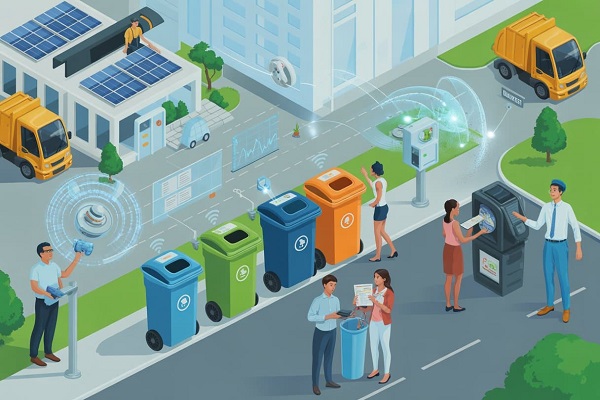
Technology also helps with dynamic route optimization for collecting recyclables. Waste management companies can use smart bins that feature ultrasonic fill-level sensors and are connected to an AI based logistics platform to eliminate one of the main inefficiencies in the waste collection industry, which is collecting bins that are half full when there is an overflow from a bin waiting to be emptied. By using real-time fill level data, current traffic conditions, and driver capacity, logistics companies such as UPS and FedEx have created dynamic route optimization systems that can calculate the best route to collect material based upon these factors. Semikron and Big Belly have demonstrated that smart waste systems can reduce collection trips by up to fifty percent in dense urban areas — saving fuel, cutting emissions, and reducing the noise and congestion of unnecessary truck movements.
Food Waste Intelligence
Food waste is responsible for approximately eight percent of global greenhouse gas emissions, more than the entire aviation industry. AI applications in food service and retail are attacking this problem at the source. Computer vision systems in restaurant kitchens photograph every tray of discarded food, identifying what is wasted most and informing purchasing and menu decisions. Winnow, a UK-based company, has helped commercial kitchens reduce food waste by up to seventy percent through this approach alone.
Impact Figure
AI route optimization in smart waste systems has demonstrated fuel savings of up to 50% in pilot programs across major European and North American cities.
Robotic Sorting
Deep learning systems recognize materials at 80+ items per minute, dramatically outperforming human sorters in speed and accuracy.
Smart Bins
IoT-connected fill sensors feed real-time data to logistics AI, eliminating unnecessary collection runs and cutting fleet emissions.
Food Waste AI
Computer vision in kitchens has achieved 70% waste reduction, tackling one of the largest but most invisible sources of emissions.

Naeem Akhtar plays a key role in shaping editorial content and maintaining the highest standards of accuracy and clarity. His dedication ensures that PNP’s coverage remains timely, reliable, and impactful for its readers worldwide.