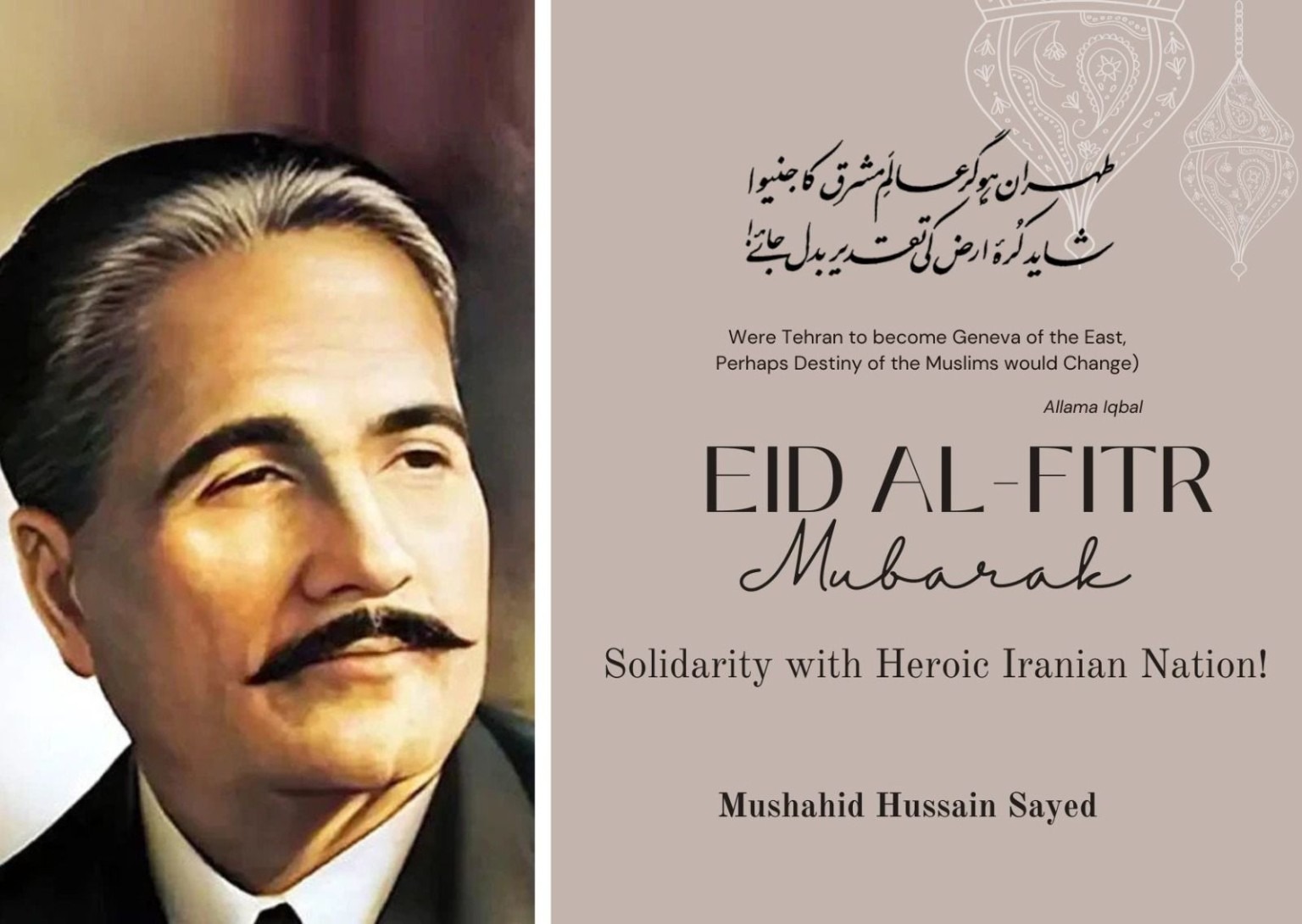
The exchange of Eid greetings among political leaders often carries symbolic meaning beyond festive wishes. This year, an Eid greeting card shared by prominent senior Pakistani politician, analyst and former Senator Mushahid Hussain Sayed has drawn intellectual and cultural attention due to its deep reference to the poetry of Allama Muhammad Iqbal and its evocative imagery of Tehran. The gesture reflects not only goodwill but also a revival of shared civilizational values rooted in literature, spirituality, and regional connectivity.
The card prominently features a portrait of Iqbal alongside a profound couplet referencing Tehran, accompanied by the message “Eid al-Fitr Mubarak” and a note of solidarity with the Iranian nation. This composition is not accidental—it reflects a layered narrative of unity, intellectual heritage, and regional harmony.
The Power of Visual and Literary Symbolism
At first glance, the greeting card conveys a festive message marking Eid-ul-Fitr, the joyous culmination of Ramadan. However, a deeper look reveals a carefully curated intellectual theme. The presence of Allama Muhammad Iqbal immediately elevates the message from a routine greeting to a philosophical reflection.
Iqbal is not merely a national poet of Pakistan; he is a global intellectual figure whose ideas resonate across the Muslim world. His poetry, especially in Persian, has a profound connection with Iran and its cultural centers, particularly Tehran.
The couplet featured on the card reads:
“Were Tehran to become Geneva of the East,
Perhaps the destiny of the Muslims would change.”
This verse encapsulates Iqbal’s aspiration for a unified and progressive Muslim world, where cities like Tehran could emerge as centers of diplomacy, intellectual discourse, and global influence—much like Geneva in the Western world.
Iqbal’s Vision: Tehran as the “Geneva of the East”
The reference to Tehran as the “Geneva of the East” is deeply significant. Allama Muhammad Iqbal envisioned a future where Muslim societies would not remain fragmented but instead establish centers of dialogue, knowledge, and unity.
In this vision, Tehran symbolizes more than a capital city—it represents a potential axis of intellectual revival. By comparing it to Geneva, a global hub of diplomacy and international cooperation, Iqbal underscores the need for the Muslim world to create its own institutions of influence and ideological leadership.
This poetic metaphor remains highly relevant today. The Muslim world continues to grapple with divisions, and Iqbal’s call for unity through intellectual empowerment is as urgent as ever.
Eid as a Moment of Collective Reflection
Eid-ul-Fitr is not just a festival of celebration; it is a moment of spiritual renewal and communal harmony. By integrating Iqbal’s poetry into the Eid greeting, Mushahid Hussain Sayed transforms the occasion into an opportunity for reflection.
The phrase “Solidarity with Heroic Iranian Nation” further strengthens this message. No doubt, Mushahid highlights a sense of brotherhood and shared identity within the Muslim Ummah. Such expressions are particularly meaningful in times when geopolitical tensions often overshadow cultural and religious bonds.
Cultural Diplomacy Through Eid Greetings
Historically, Pakistan and Iran share deep-rooted connections:
-
Persian language influenced Urdu literature
-
Common sufi traditions shaped spiritual thought
-
Intellectual exchange flourished through figures like Iqbal
By invoking Allama Muhammad Iqbal and Tehran, the greeting card subtly revives this shared heritage, reminding audiences of a time when cultural unity transcended political borders.
The Role of Iqbal in Iran
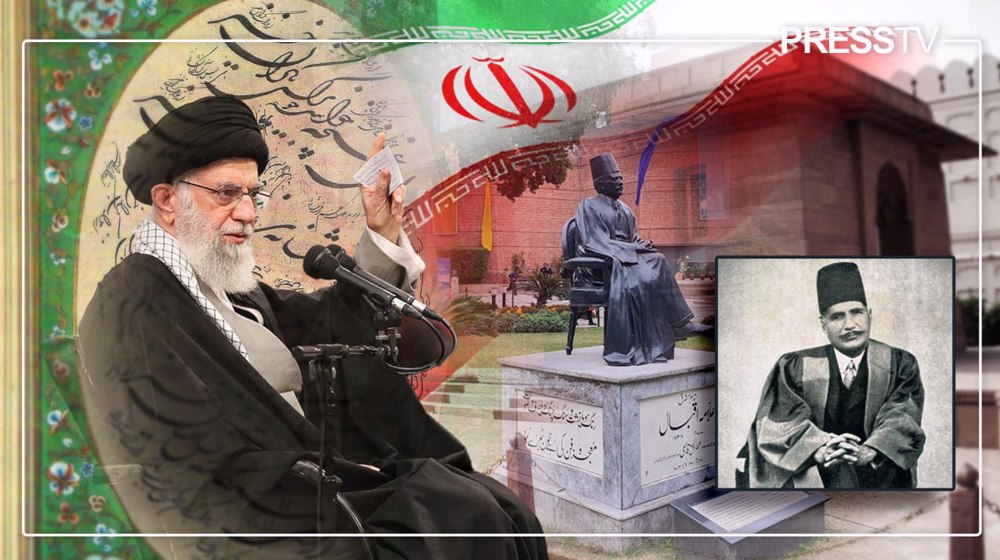
It is important to note that Allama Muhammad Iqbal enjoys immense respect in Iran, where he is often referred to as Iqbal-e-Lahori. His Persian works are widely studied, and his philosophy of Khudi (selfhood) has influenced Iranian intellectual discourse for decades.
In this context, the inclusion of Iqbal’s poetry in the Eid card serves as a bridge between two nations, reinforcing mutual admiration and intellectual kinship.
A Message Beyond Borders

What makes this Eid greeting particularly impactful is its ability to transcend national boundaries. While it originates from Pakistan, its message resonates across the broader Muslim world.
The themes embedded in the card include:
-
Unity of the Ummah
-
Respect for intellectual heritage
-
Hope for a joint future
-
Solidarity in challenging times
These are universal values that align perfectly with the spirit of Eid.
Contemporary Relevance
In today’s fragmented global environment, symbolic gestures like this carry significant weight. The Muslim world faces numerous challenges, from political instability to cultural disconnection. In such a scenario, revisiting the ideas of Allama Muhammad Iqbal becomes essential.
Iqbal’s emphasis on self-awareness, unity, and intellectual progress provides a roadmap for revival. By highlighting these themes in an Eid greeting, Mushahid Hussain Sayed effectively merges tradition with contemporary relevance.
Conclusion: Eid Greeting as Intellectual Expression
In an era where political messaging often becomes transactional and routine, a thoughtfully designed Eid greeting card can transcend mere formality and emerge as a powerful cultural and intellectual statement. The Eid-ul-Fitr card shared by Mushahid Hussain Sayed, known for his intellectual depth and diplomatic experience, stands out as a remarkable example, weaving together spirituality, poetry, and geopolitics through the timeless vision of Allama Muhammad Iqbal.
By drawing on the vision of Allama Muhammad Iqbal and the symbolic importance of Tehran, Mushahid Hussain delivers a powerful reminder of the Muslim world’s shared heritage and collective potential.
As Muslims around the world celebrate Eid-ul-Fitr, such messages encourage not only joy and gratitude but also reflection on unity, identity, and the future of the Ummah. In this sense, the card stands as an example of how cultural expression can inspire deeper understanding and meaningful dialogue in a complex situation.
Dr. H. Zafar is a distinguished writer and analyst associated with Press Network of Pakistan as Associate Editor. With a strong academic background and years of research experience, she brings depth, clarity, and analytical rigor to her writings.