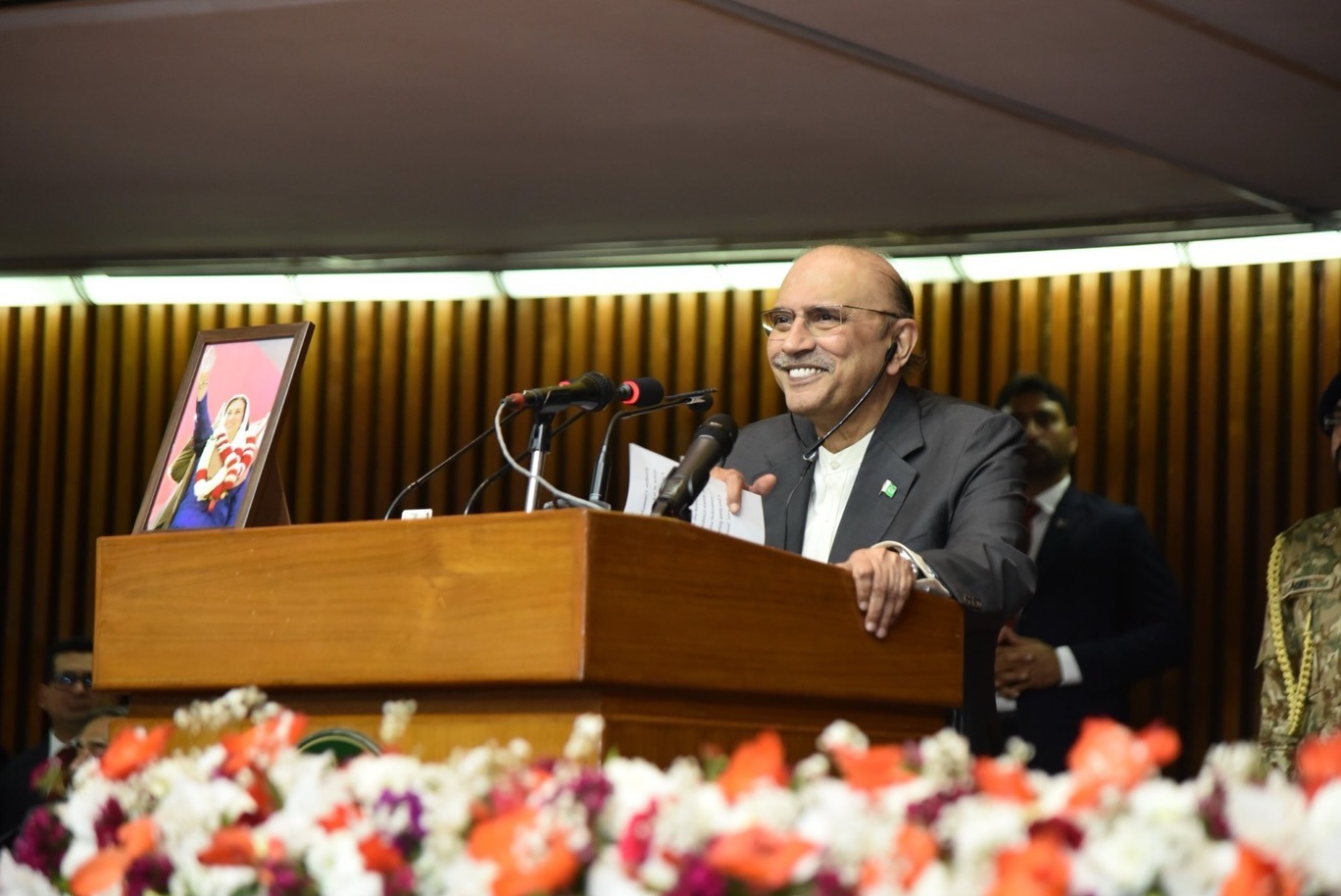
ISLAMABAD (Sabahuddin Qazi) – President of Pakistan Asif Ali Zardari delivered a compelling and strategically charged address to the joint session of Pakistan’s Parliament, marking the beginning of the 9th parliamentary year. This address, delivered amidst heightened regional tensions and security concerns, combined constitutional affirmation, national resolve, and diplomatic messaging in a broad narrative aimed at reinforcing Pakistan’s sovereignty, democratic strength, and economic priorities.
During his historical address, he once again placed a portrait photo of his late spouse Shaheed Mohtarma Benazir Bhutto on the dais, which is not only a symbol of devotion but also of democratic struggle for him. This scene was once again expressing President Zardari’s deep commitment to Benazir Bhutto’s immortal political legacy and democratic values in the parliament.
A Constitutional Tradition with Renewed Urgency
In accordance with constitutional requirements under Articles 54 and 56, the President Zardari convened the joint sitting of both Houses of Parliament on March 2, 2026 to present a policy framework for the coming year. Traditionally, this address sets the legislative and strategic tone for the parliamentary session ahead, outlining national priorities and highlighting governance challenges.
The security situation surrounding the session was notably tense: entry was tightly controlled, media access limited, and strict protocols were enforced to ensure safety — reflecting broader regional instability and internal political divisions.
Opening Remarks by President Zardari
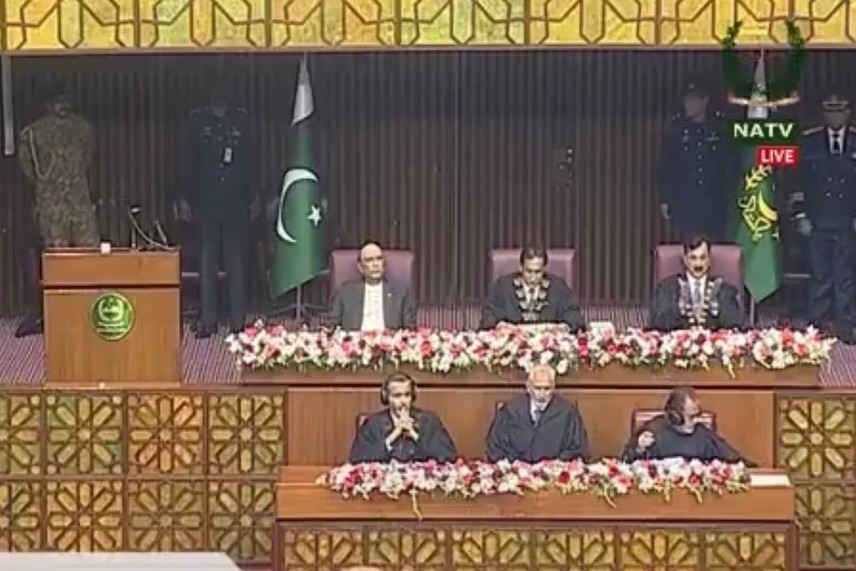
President Zardari began in the traditional Islamic invocation, emphasizing the honour and constitutional duty of addressing Parliament for the ninth time as a twice-elected President. He framed each speech as a reaffirmation of Pakistan’s democratic institutions and collective responsibilities towards the electorate.
He highlighted that the resilience of Pakistan’s democratic system is rooted in the rule of law, constitutional governance, and the strength of its armed forces — a narrative designed to unify political stakeholders in the face of both internal and external pressures. The address served as a reminder of the legislature’s central role in national governance.
Security Challenges and Strategic Posture
A significant portion of the speech was dedicated to national security. President Zardari reiterated Pakistan’s readiness to thwart any aggression and warned that any external force contemplating hostile actions should prepare for a humiliating defeat. This warning, while stern, also doubled as a diplomatic message aimed at encouraging negotiation over confrontation.
He appealed directly to India, urging a strategic shift from “war theatres” to “meaningful negotiations,” stating that such dialogue is the only path to durable regional security. The President emphasized Pakistan’s support for the legitimate rights of the people of Jammu and Kashmir, ensuring both moral and diplomatic backing for their cause.
This section balanced deterrence with a clear call for diplomacy — signalling that Pakistan seeks peace but will not compromise on its territorial integrity or sovereign rights.
Border Security and Regional Stability
Turning to the western border, Zardari reiterated that Pakistan will not allow its territory to be used to destabilize its peace, a direct reference to cross-border incidents attributed to militant groups operating from Afghanistan — and a reaffirmation that diplomatic patience has limits.
He invoked Article 51 of the UN Charter to justify Pakistan’s right to self-defense, asserting that the nation has revealed only a portion of its capabilities and reserving the right to respond decisively to any future provocations.
This justified use of international norms aimed to align Pakistan’s security posture with legal and global frameworks. It projected a narrative of a responsible, law-abiding state that is nevertheless prepared for all contingencies.
Honouring the Armed Forces and Martyrs
A defining theme in the speech was acknowledgment of the sacrifices made by the armed forces and security institutions. Beyond mere rhetoric, Zardari conveyed deep respect for the military’s professionalism in responding to threats.
The President extended heartfelt sympathy to the families of martyred soldiers, noting that each martyr leaves behind a grieving family that has contributed profoundly to the nation’s stability and security.
This segment reinforced the unity between Pakistan’s civilian leadership and its military institutions, underlining shared commitments to safeguarding the country.
Domestic Cohesion: Unity Over Division
Despite the seriousness of external threats, Zardari also addressed the need for political unity at home. Though opposition members staged protests during his address, chanting slogans against him, the President’s message called for cross-party cooperation in confronting national challenges.
He reaffirmed his belief that Pakistan’s federation is strengthened through harmony, not centralization, urging constitutional forums like the Council of Common Interests to be proactively engaged.
Further, he underscored that equitable development — particularly in historically underdeveloped regions like Balochistan — is essential for long-term stability and national integration.
Economic Vision and Development Agenda
President Zardari tied economic strength directly to national security. He emphasized that economic stability forms a pillar of sovereignty, laying out priorities such as:
-
Expanding the tax net fairly and efficiently
-
Implementing energy reforms
-
Promoting agricultural growth
-
Ensuring climate resilience
-
Empowering the vulnerable through social safety nets
Zardari highlighted that a stable economy is not solely about GDP numbers but about creating an environment where ordinary citizens can thrive and contribute to national success.
His remarks resonated with earlier policy statements that prioritized inclusive infrastructure, SME growth, and improvements in livelihood sectors — themes echoed in previous annual addresses.
Foreign Relations: Balance of Principles and Partnerships
On the international stage, Zardari reiterated Pakistan’s longstanding positions:
-
Support for an independent Palestinian state within pre-1967 borders
-
Endorsement of Iran’s sovereignty and territorial integrity
-
Appreciation for countries that contributed to regional de-escalation
He also noted strengthened ties with strategic partners such as the United States and China, with initiatives like CPEC 2.0 expected to bring transformative infrastructure growth and economic opportunity.
This broader diplomatic narrative sought to position Pakistan as a constructive player — aligned with peace, respectful of international norms, and committed to regional development.
Social Priorities and Inclusive Governance
In a notable portion of the speech, Zardari highlighted the importance of women’s empowerment — emphasizing digital access, safety, and economic autonomy as critical for national progress.
This inclusion underscored a vision of inclusive governance where all segments of society, especially youth and women, have a stake in Pakistan’s future.
Closing Appeal: Unity, Constitution, Progress
In concluding his remarks, President Zardari wove together the three pillars he believes most crucial for Pakistan’s path ahead: security, economic prosperity, and constitutional governance. He invoked national unity and invoked a shared purpose: to protect sovereignty, eliminate terrorism, and forge a stable and prosperous Pakistan.
His closing words — “Pakistan Zindabad” and “Parliament Paindabad” — echoed both patriotic sentiment and confidence in democratic institutions.
Final Thoughts
President Zardari’s address to the 9th Parliamentary Year was more than a usual policy speech — it was a strategic narrative designed to affirm Pakistan’s sovereignty, reaffirm democratic resilience, confront security challenges with resolve, and promote a forward-looking development agenda.
By balancing tough deterrent messaging with calls for diplomacy and unity, the speech aimed to reassure domestic and international audiences that Pakistan remains steadfast, responsible, and committed to peace and progress in a complex regional environment.
Mr. Sabahuddin Qazi is an Islamabad-based researcher and analyst.