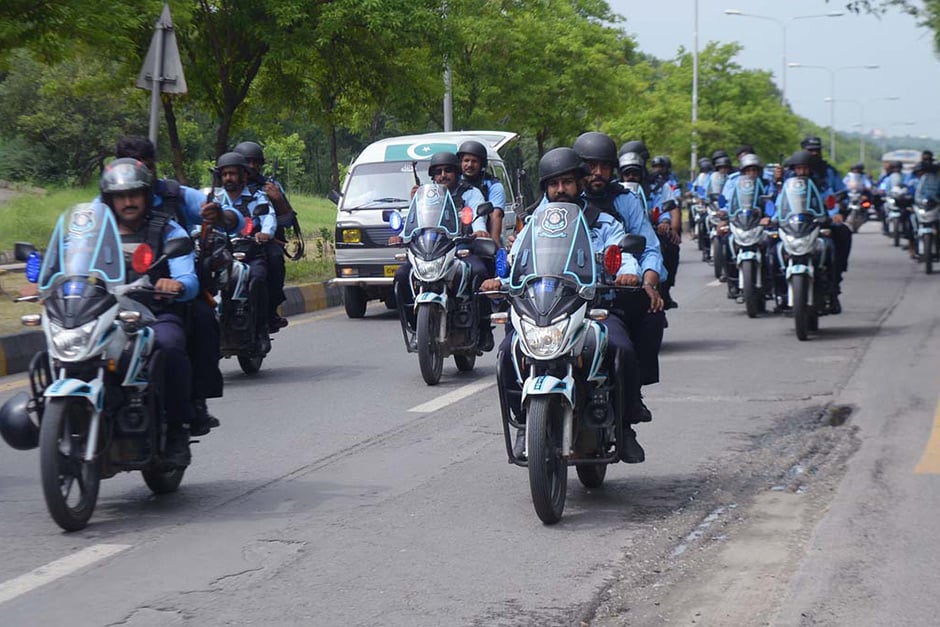
ISLAMABAD (Czechangez Khan Jadoon): The Islamabad Police has announced a major reshuffle of Station House Officers (SHOs), replacing the leadership at nine police stations across the federal capital. A formal notification has been issued, marking a notable reorganisation within the city’s law enforcement framework as authorities move to enhance operational effectiveness and public safety.
What the Reshuffle Entails
According to the official notification, signed by Capt. (R) Qazi Ali Raza, PSP, Senior Superintendent of Police (Operations), Islamabad, SHOs commanding the following police stations have been transferred and replaced with new officers:
-
Bani Gala Police Station
-
Sabzi Mandi Police Station
-
Secretariat Police Station
-
Tarnol Police Station
-
I-9 Police Station
-
Margalla Police Station
-
Aabpara Police Station
-
Nilore Police Station
-
Bara Kahu Police Station
These deployments were carried out through an administrative order and are effective immediately, reflecting the Islamabad Police leadership’s intention to revitalise policing efforts across diverse city zones.
Newly Posted SHOs in Islamabad
All postings,a ccording to the Islamabad Police, have been made on administrative grounds with immediate effect and shall remain in force until further orders.
| S. No. | Name | From | Posted As |
|---|---|---|---|
| 1 | Inspector Asif Khan | Investigation Wing, Islamabad | SHO, Police Station Bani Gala |
| 2 | Inspector Muhammad Saleem Raza | SHO, Police Station Margalla | SHO, Police Station Secretariat |
| 3 | Inspector Aamir Abbas | Police Line Headquarters, Islamabad | SHO, Police Station Tarnol |
| 4 | Sub-Inspector Muhammad Kamal | Dolphin ERU, Islamabad | SHO, Police Station I-9 |
| 5 | Sub-Inspector Hakim Ali | SSP Operations Office, Islamabad | SHO, Police Station Sabzi Mandi |
| 6 | Sub-Inspector Tanveer Hussain Magsi | Rescue-15, Islamabad (DIB) | SHO, Police Station Bara Kahu |
| 7 | Sub-Inspector Muhammad Imran Munir | Police Station Karachi Company | SHO, Police Station Margalla |
| 8 | Sub-Inspector Muhammad Yousaf | Police Station Humak | SHO, Police Station Nilore |
| 9 | Sub-Inspector Nawazish Ali Khan | Police Station Kohsar | SHO, Police Station Aabpara |
Why the Shake-up?
While official statements from the police have been concise, several factors likely contributed to this reshuffle:
1. Crime Trends in the Capital Are a Key Concern
Recent data shows the ICT recorded 55 separate crime incidents in just one week, including vehicle thefts, armed robberies, and street crimes. Areas under some police jurisdictions — such as Subzi Mandi, Tarnol, Khanna, and Industrial Area — have emerged as high-risk zones with a growing pattern of criminal activity.
Such crime patterns put pressure on police leadership to reassess performance at the station level. SHOs are critical to local policing efforts, as they lead investigations, manage station resources, engage with communities, and coordinate with higher command — meaning changes in these roles can reshape how law enforcement responds to security issues.
2. Administrative Priorities and Public Expectations
In recent weeks, Islamabad Police leadership under Inspector General of Police (IGP) Syed Ali Nasir Rizvi has emphasised strengthening community-oriented policing and transparent complaint resolution mechanisms such as the IGP Complaint Cell (1715). Operational directives have signalled a shift toward greater accountability, responsiveness to citizen grievances, and a merit-based approach to policing.
Leadership transitions among SHOs are often used as an administrative tool to inject fresh energy into stations that may be struggling with performance or public trust issues.
Letters of Posting: What’s Changed on the Ground
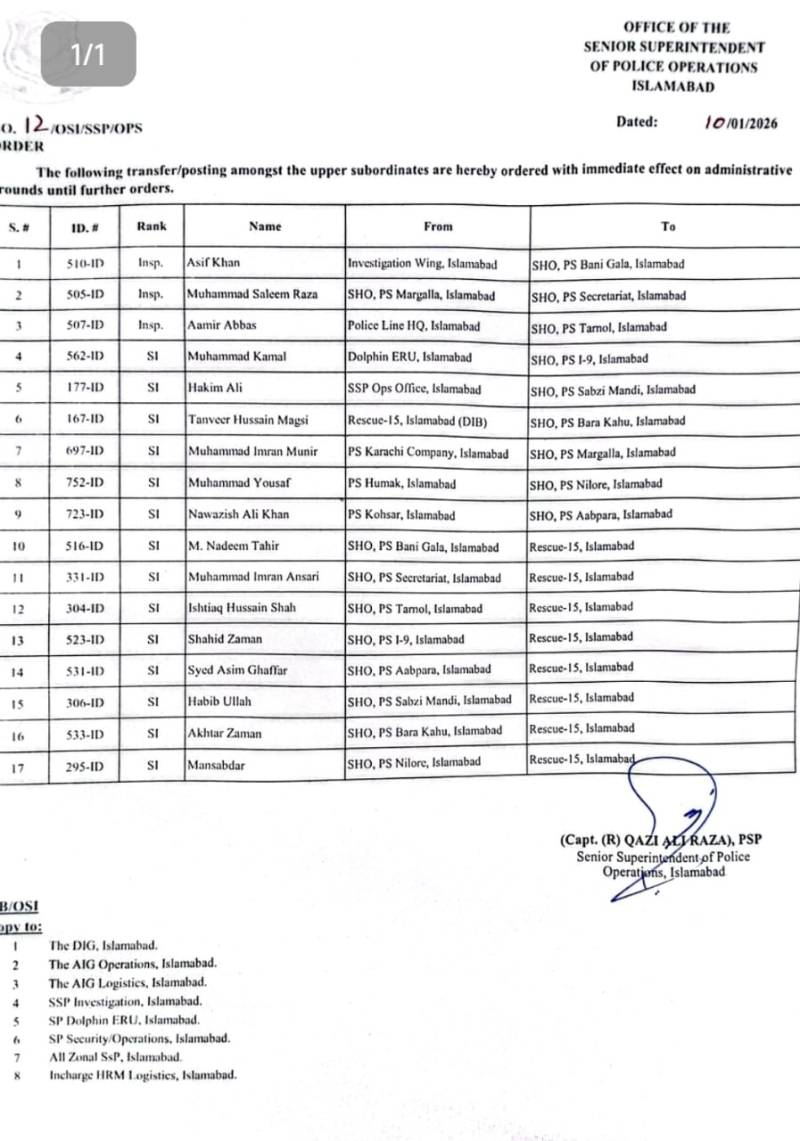
While comprehensive station-by-station performance reviews have not been publicly disclosed, official notification documents make it clear that the reshuffle is widespread. Differences between the old and new line-up include:
-
Assigning new SHO leadership at established urban-centered stations like I-9 and Secretariat.
-
Strategic postings at residential precincts such as Bani Gala, where social crimes are on rise.
-
Reassignments at rapidly evolving suburban or transit-oriented precincts like Tarnol and Nilore.
These moves suggest an attempt by senior leadership to blend experience with a renewed operational mandate at key nodes across the city.
What Islamabad Police Leadership Has Said
In early January 2026, top Islamabad Police officials held open courts (“khuli kachehris”) to hear citizen complaints and directed immediate redressal from zonal officers.
Furthermore, senior leadership has used public platforms — including social media — to underscore their commitment to fair investigations, merit-based police administration, and continuous dialogue with communities.
Context: Previous Reshuffles and Crime Efforts
The January 2026 reshuffle is not an isolated event. Over the past year and a half, Islamabad Police has periodically adjusted personnel across ranks. Prior reports emerged in June 2024 revealed transfers of 16 SHOs due to persistent crime control issues, where officers were relocated after failing to stem trend lines in thefts and armed street robberies.
Similarly, in late 2025, smaller transfers involved four SHO replacements focused on administrative strengthening. These adjustments indicate an ongoing review of field leadership to align with evolving operational demands. Last year, four Station House Officers (SHOs) from different police stations in Islamabad have been suspended for negligence in carrying out their duties and failing to control rising crime rates.
The Role of SHOs: Why This Matters for Islamabad Police
Station House Officers serve at the heart of police-citizen interaction in Islamabad:
-
They are responsible for crime reporting and FIR registration, which is a cornerstone of justice access.
-
SHOs oversee crime investigations, patrol deployment, and coordination with investigative units.
-
They manage community outreach and sit at the front line of addressing public safety concerns.
Any large-scale transfer of SHOs — such as the recent nine-station reshuffle — inherently signals an attempt to reset the approach of policing at a neighborhood level.
Public Expectations and Accountability
Residents of Islamabad often view SHO appointments as a key indicator of policing effectiveness in their locality. Public expectations remain high regarding:
-
Prompt response to complaints
-
Fair and transparent investigations
-
Improved law and order situation
Islamabad Police officials stress that performance of newly posted SHOs will be closely monitored, and further administrative action may be taken based on results.
Challenges and Opportunities Ahead
Despite the reshuffle, there are several persistent challenges:
-
Rapid urban growth in Islamabad continues to strain police resources.
-
Crime patterns, especially vehicle theft and street snatching, demand proactive policing rather than reactive measures alone.
-
Enhancing trust between citizens and police remains a long-term endeavor requiring consistent performance from officers at every level — with SHOs playing a critical role.
That said, the Islamabad Police reshuffle also presents opportunities:
-
A fresh set of leadership perspectives can invigorate crime prevention and community engagement strategies.
-
Aligning SHOs with areas that match their skill sets may improve problem-solving on persistent law-and-order issues.
-
Resetting administrative expectations can foster accountability and drive performance improvements across precincts.
Rising Crime Concerns in Residential Areas
The reshuffle comes at a time when residents of several residential sectors of Islamabad, particularly Bani Gala, Bara Kahu, Nilore, Sabzi Mandi and surrounding localities, have repeatedly raised concerns over a noticeable increase in street crime. Complaints related to vehicle theft, motorcycle snatching, house burglaries, mobile phone snatching and suspicious activity during late hours have been reported to Islamabad Police from these areas in recent months. Due to their expanding populations, mixed residential layouts and proximity to rural settlements, these localities pose unique policing challenges, prompting Islamabad Police to place fresh and experienced leadership at the station level to improve surveillance, response time and community engagement.
Looking Forward
The impact of this reshuffle by the Islamabad Police will hinge on measurable outcomes in the coming months — including reported crime rates, response times, and community satisfaction surveys. Islamabad residents, media and civic watchdogs will be watching closely to see how new SHOs integrate into their roles and whether these changes translate into safer streets.
As Islamabad Police continues to adapt to the challenges of the capital — balancing public expectations with practical policing constraints — strategic personnel decisions like this reshuffle will play a key role in shaping the city’s law enforcement narrative in 2026 and beyond.
Czechangez Khan Jadoon is a senior journalist covering crime, law enforcement, and civic affairs, with a focus on public safety and administrative developments in Islamabad. He is also President of the Patriotic Journalists of Pakistan (PJP).